


Thomas Hobbes
Last updated: 2025-12-16
Categories: Home -> Political Science
This article is part of the Basic Course on Libertarianism and the Austrian School of Economics-> Module 3: Political Institutions
To understand the life of Thomas Hobbes (1588–1679), one must understand that it was a long and often turbulent existence, defined by an obsessive search for security and peace in times of chaos. He lived through the Anglo-Spanish War (1585–1604). His philosophy was born directly from his life experiences with war and fear.
Personal life and formation
Fear and I were born twins
This phrase of Hobbes’s own summarizes his beginning. His mother gave birth prematurely on 5 April 1588 in Westport, England, terrified by the news that the Spanish Invincible Armada was approaching to invade England.
-
Humble origin: His father was an uneducated and alcoholic clergyman who abandoned the family after a fight at the church door. Thomas was raised by a prosperous uncle (a glove maker) who financed his education.
-
Classical education: He was a child prodigy in classical languages and at age 14 entered the University of Oxford. However, he did not like the Aristotelian scholasticism taught there; he preferred to read maps and travel books.
Details regarding his premature birth (Press to expand)
In the case of Thomas Hobbes, his premature birth (attributed by himself to his mother’s fear of rumors about the Invincible Armada, which had not yet sailed but was generating panic in England) occurred in an era when medicine was very limited, especially for premature babies. There was nothing like modern neonatal intensive care units (incubators were only invented in the 1880s in France).
How premature births were handled in late 16th-century England
- Main care: Births were attended almost exclusively by midwives, experienced women of the community (often without formal training, but learned by practice). Male physicians only intervened in extreme and complicated cases, and rarely in normal or premature births.
- Survival: Infant mortality was extremely high (up to 200–300 per 1,000 births in the first years). A premature baby had little chance of surviving, especially if very small or weak. Many died from hypothermia, infections, or respiratory problems.
- Basic care for prematures (when they survived the birth):
- Keeping warm: The most important and common. The baby was wrapped in wool cloths or skins, placed near the fire or in a heated cradle. Sometimes hot-water bottles were used, or the baby was put in a lukewarm oven (yes, literally, a slightly heated bread oven to simulate body heat!).
- Feeding: If the mother could not breastfeed (common with weak prematures), a wet nurse who could nurse the baby was used. Breast milk was the only viable option; there were no artificial formulas. In extreme cases, manual feeding with diluted goat or cow milk was attempted, but it was risky.
- Other methods: Baths in wine or oil to “strengthen” the skin, herbal ointments, prayers and amulets (a mix of folk medicine and religion). There was no oxygen, antibiotics, or monitoring.
- Social context: In families like Hobbes’s (middle-lower class, father a vicar), care was domestic and communal. Hobbes survived thanks to basic care and luck; his longevity (91 years) was exceptional.
Hobbes joked about it: “My mother gave birth to twins: myself and fear,” relating it to his pessimistic philosophy of human nature.
In the service of the powerful and the Grand Tour
Upon graduating, Hobbes obtained employment that would define the rest of his economic and social life: tutor to the Cavendish family (Earls of Devonshire).
- Access to the elite: He lived under the protection of this powerful family, which gave him access to books, connections, and financial security.
- Travels through Europe: As tutor, he traveled through France and Italy (the Grand Tour). These journeys were crucial because they allowed him to meet the brightest minds of the scientific revolution, such as Galileo Galilei and the circle of René Descartes. From them he learned the geometric method and the idea that the universe is matter in motion, something he would later apply to politics.
The Civil War: The catalyst of his thought
Hobbes’s life changed drastically in the 1640s. England sank into a bloody Civil War between the royalists (supporters of King Charles I) and the parliamentarians.
- Exile: Fearing for his life because of his monarchical writings, Hobbes fled to Paris in 1640, where he remained in exile for 11 years.
- The gestation of Leviathan: It was in this context of violence and anarchy that Hobbes became convinced that the natural state of man is a “war of all against all.” The only solution, he thought, was an absolute power that imposed order.
The return and the controversy
In 1651, he published his masterwork, Leviathan. Curiously, the book angered everyone:
- The royalists did not like it because Hobbes did not defend the divine power of kings, but a rational social pact.
- The Church did not like his materialism and accused him of atheism.
He returned to England under the protection of Cromwell’s new regime (and was later readmitted to court after the Restoration of Charles II, who had been his mathematics pupil in exile), but he always lived under the shadow of suspicion.
An extraordinarily active old age
Unlike many of his contemporaries, Hobbes lived to 91 years.
- Physical vitality: It is said he played tennis until age 75 and sang at the top of his lungs in his room to exercise his lungs.
- Intellectual activity: At age 84 he wrote his autobiography in Latin and, incredibly, at age 86 he translated the Iliad and the Odyssey into English simply because “he had nothing better to do.”
- Death: He died in 1679 after a stroke of paralysis, having said before dying that his last journey would be “a great leap in the dark.”
What inspired Thomas Hobbes’s ideas?
If Jean-Jacques Rousseau was the idealist who believed in natural goodness, Thomas Hobbes was the realist (or pessimist, depending on how one looks at it) who believed that, without a strong power, we would destroy one another.
His ideas did not arise from nothing; they were the result of a violent historical context and a fascination with modern science. These are the great sources of inspiration of Hobbes:
1. The trauma of the English Civil War
This is, without doubt, his greatest negative “muse.” Hobbes lived through the bloody civil war between the supporters of King Charles I and Parliament.
- The lesson: Seeing the chaos, death, and anarchy, Hobbes reached a radical conclusion: the worst of evils is the lack of order (the state of nature).
- He preferred an absolute ruler, even if tyrannical, rather than the horror of a civil war where life is “solitary, poor, nasty, brutish, and short.”
2. Galileo Galilei and “Motion”
Hobbes met Galileo personally in Italy and was fascinated by his discoveries about physics and kinematics.
- The idea: If the universe is explained by bodies in motion, the human being and society must also be explained that way.
- Inspiration: Hobbes applied mechanism to politics. For him, man is a “machine” moved by desires (attraction) and fears (repulsion). The State, therefore, is an “artificial man” (the Leviathan) composed of these mechanical pieces.
3. Euclid and Geometry
It is said that Hobbes discovered Euclid’s Elements at age 40 and fell in love with deductive logic.
- The method: Hobbes wanted politics to be an exact science, as rigorous as geometry.
- Instead of basing himself on morality or religion, he wanted to start from simple axioms (such as “man seeks to survive”) and deduce from them the whole structure of the State.
4. Thucydides: The mirror of history
Before writing his great works, Hobbes translated from Greek Thucydides’ History of the Peloponnesian War.
- Realism: From Thucydides he learned that human beings act from three main motives: honor, fear, and profit.
- This “naked” vision of human nature, without religious adornments, was the basis on which he built his theory that man is a wolf to man (Homo homini lupus).
5. The rejection of Aristotle
Much of Hobbes’s work was a “reaction against” Aristotle.
- Aristotle said that man is a “political animal” by nature.
- Hobbes said: “A lie.” Man is a solitary and selfish animal by nature, and only becomes social out of convenience and fear. Society is not something natural; it is an artificial “contract.”
Hobbes was the first to try to strip “magic” and “religion” from politics in order to treat it as a problem of social engineering.
What books did Thomas Hobbes write?
- The Elements of Law, Natural and Politic (1640, circulated in manuscript; published in 1650). His first systematic exposition of political philosophy.
- De Cive (Elementorum Philosophiae Sectio Tertia De Cive, 1642; also known as Philosophical Elements concerning the Citizen or Treatise on the Citizen). Part of the trilogy, centered on political theory.
- Leviathan, or The Matter, Forme and Power of a Commonwealth Ecclesiasticall and Civil (Leviathan, 1651). His most famous work, where he develops the theory of the social contract, the state of nature, and the need for an absolute sovereign.
- De Corpore (Elementorum Philosophiae Sectio Prima De Corpore, 1655). Treats logic, first philosophy, and physics.
- De Homine (1658). Addresses optics, anthropology, and psychology.
- Behemoth (Behemoth or The Long Parliament, written around 1668; published posthumously in 1682). Historical analysis of the English Civil War.
What is Thomas Hobbes’s political thought?
Thomas Hobbes is one of the founders of modern political philosophy. His thought, set out mainly in Leviathan, centers on the need for a strong state power to avoid chaos and guarantee peace.
Key ideas of Hobbes’s political thought
-
The state of nature
Hobbes describes the state of nature as a hypothetical condition without government or common laws. In it, human beings are equal in capacity (physical and intellectual), but driven by egoism, fear, and competition for limited resources. This leads to a “war of all against all” (bellum omnium contra omnes), where life is “solitary, poor, nasty, brutish, and short.” There is no natural morality or justice; only each one’s unlimited right to everything necessary for his preservation. -
The social contract
To escape this chaos, individuals, guided by reason and fear of violent death, agree on a mutual pact. They renounce their natural liberty and transfer their rights to a sovereign (who may be a monarch or an assembly). This contract is irrevocable: once established, it cannot be dissolved without returning to the state of war. -
The absolute sovereign (the Leviathan)
The sovereign receives absolute, indivisible, and unlimited power. His function is to maintain peace, impose laws, and monopolize force. He is not subject to the contract (only the individuals pact among themselves), so he cannot be judged or legitimately resisted (except in extreme cases of direct threat to life). Hobbes prefers monarchy, but accepts any form that guarantees order. The Leviathan is a biblical metaphor for an artificial “monster” created by men for their protection.
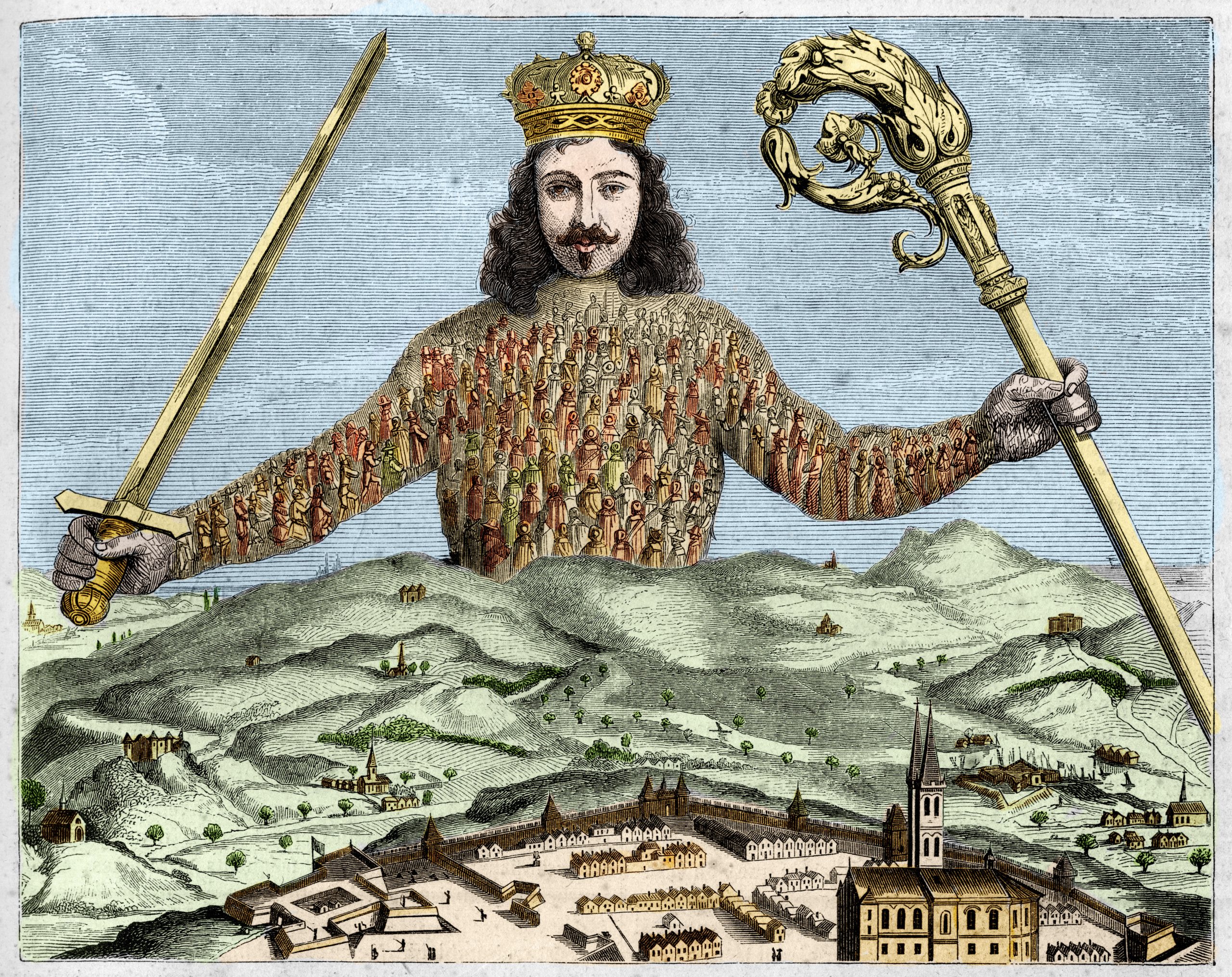
Frontispiece and iconic illustration of Leviathan
The most emblematic image shows the sovereign as a giant composed of hundreds of individuals (symbolizing that the State is an “artificial body” made of the citizens), holding a sword (coercive power) and a crozier (civil power), dominating a peaceful landscape.
Context and legacy
Influenced by the English civil wars, Hobbes justifies absolutism as the lesser evil against disorder. His materialist and pessimistic vision of human nature contrasts with later thinkers such as John Locke (more optimistic and liberal). Although criticized as authoritarian, his theory of the social contract and sovereignty influenced modern thought on the State and power.
In summary, for Hobbes, politics is based on rational fear: only absolute power can overcome human egoism and secure collective survival.
What is Thomas Hobbes’s ethical thought?
Hobbes developed an ethics deeply tied to his political and anthropological philosophy, set out mainly in works such as De Cive, Leviathan, and The Elements of Law, Natural and Politic. His ethical thought is materialist, egoistic, and rational, rejecting traditional views based on Aristotelian virtues or divine natural law.
Key ideas of Hobbes’s ethical thought
-
Human nature as egoistic and driven by passions
Hobbes sees the human being as a mechanism driven by the desire for self-preservation. Passions dominate: fear of death, search for power and glory. There is no Aristotelian “supreme good”; the good is what each one desires, and the bad what he avers (especially violent death). This view is psychologically egoistic: everyone acts from self-interest. -
The state of nature and the absence of natural morality
Without society or laws, there is no objective good or evil, nor justice or injustice. There is only an unlimited “natural right”: each one has a right to everything necessary to preserve his life. This generates a perpetual war, where ethics is reduced to survival. -
The laws of nature as dictates of reason
To escape chaos, reason dictates natural laws (not divine, but rational): prudential precepts for peace. The first and fundamental is to seek peace when possible. From it derive the others, such as not doing to others what you do not want done to you, keeping covenants, gratitude, etc. These laws are eternal and immutable, but in the state of nature they are ineffective without a coercive power. -
Morality as conventional and dependent on the sovereign
True ethics arises only in civil society, through the social contract. By creating the Leviathan (absolute sovereign), individuals transfer rights and accept the sovereign’s laws as the source of good and evil. Obedience is the principal moral duty; justice is keeping covenants. Hobbes is an ethical conventionalist: the just is what is commanded by the sovereign.
Critiques of his ethical ideas
Hobbes influenced utilitarianism and modern contractualism, but was criticized for his psychological egoism (why be moral if only oneself matters?) and for justifying absolutism (morality depends on power, which could legitimize tyrannies). His ethics is pragmatic: morality is not altruistic or divine, but a rational instrument for collective survival.
For Hobbes, ethics is grounded in rational egoism: natural laws guide toward the pact that creates an obligatory civil morality under absolute power. Without the State, no true ethics is possible.
Can Hobbes be considered a Natural Law thinker?
Thomas Hobbes is a very complex transitional figure; one can say that in a certain sense he was a natural-law thinker.
While for most natural-law thinkers the “natural laws” are limits on the power of the king, for Hobbes they are the very reason that justifies absolute power.
1. The starting point: Natural Right
For Hobbes, natural right is not a list of moral values (such as “thou shalt not kill”), but a biological and rational instinct.
- The right to everything: In the “State of Nature” (before government existed), man has a right to everything, even to the body of others, to secure his self-preservation.
- Absolute liberty: It is the right of each man to use his own power as he wishes to preserve his own life.
2. The Laws of Nature
Hobbes defines the natural laws as “precepts of reason.” For him, human reason discovers that, in order not to die in a war of “all against all,” man must follow certain rules. The three main ones are:
- Seek peace as long as it is possible.
- Renounce the right to all things (cede part of your liberty) if others do so as well.
- Keep the covenants that have been made.
3. The turn toward Absolutism (His difference from others)
This is where Hobbes separates from traditional natural law:
- The social contract: For Hobbes, natural law dictates that we must create a common power so strong that it forces us to keep the peace. That power is the Leviathan (the State).
- Once the State is created, natural law stops: Hobbes argues that, once citizens cede their power to the Sovereign, this Sovereign has absolute authority. The citizen can no longer appeal to “natural law” to disobey the king (except if the king tries to kill him directly).
- He passes from Natural Law to Positivism: Although he uses natural law to explain the origin of the State, once the State exists, Hobbes becomes the father of legal positivism: the law is what the Sovereign says it is.
In summary: Hobbes was a natural-law thinker because he believed that the foundation of the State lies in the rational nature of man and in his desire for survival, but he used that idea to defend a totalitarian state power.
Critiques of his ideas
Thomas Hobbes received numerous critiques from his own era to the present, both from contemporaries and from later philosophers. His ideas, especially in Leviathan (1651), were controversial for their anthropological pessimism, materialism, and defense of absolutism. Below are the main critiques, organized thematically.
1. Political absolutism and lack of limits on power
The most common critique is that Hobbes justifies a sovereign with absolute and indivisible power, without control mechanisms or a right of resistance (except extreme self-defense). This could legitimize tyrannies. Liberal philosophers such as John Locke (in Two Treatises of Government, 1689) argued that the social contract preserves inalienable natural rights (life, liberty, property) and allows rebellion against a tyrannical ruler.
2. Pessimistic and exaggerated vision of the state of nature
Hobbes describes the state of nature as a “war of all against all,” with life “solitary, poor, nasty, brutish, and short.” Critics such as Locke see it as more benign: humans are rational, social, and respect natural rights, with occasional conflicts but not total chaos. Others (such as Jean-Jacques Rousseau) argue that Hobbes projects vices of civil society onto the natural state.
3. Psychological egoism and reduction of morality
Hobbes bases ethics on egoism: humans act only from self-preservation and desire for power. Critics such as Bishop Bramhall (in debates on liberty) or Hutchesonians argue that there are altruistic motivations, natural benevolence, or an innate moral sense. This makes his theory unable to explain genuine virtue.
4. Materialism and implicit atheism
In his time, Hobbes was accused of atheism for his materialism (everything is body in motion, even God could be material) and for subordinating religion to the State (the sovereign interprets the Scriptures). This provoked censorship and temporary exile of his works.
5. Other modern critiques
- Feminists (such as Carole Pateman) critique that his contract excludes women and families from the public sphere.
- Republicans (such as Quentin Skinner) see his theory as excessively monarchical, ignoring traditions of civic liberty.
- Some accuse him of deficient historicism: his state of nature is hypothetical, not historical.
Despite the critiques, Hobbes is valued for his secular rigor and foundational role in the theory of the modern State. His ideas influenced contractualism, though moderated by liberal thinkers.
What personal critiques did he receive?
Thomas Hobbes faced numerous intense personal critiques during his life, beyond the intellectual ones of his ideas. In 17th-century England, marked by civil wars, religious conflicts, and monarchical restoration, his works (especially Leviathan, 1651) generated scandal and made him a highly controversial figure.
Main personal critiques and attacks
-
Accusations of atheism and heresy
Hobbes was widely branded an atheist (or “the atheist of Malmesbury,” his birthplace). His materialism (everything is matter in motion; even the soul and God could be corporeal) and his idea that the sovereign controls official religion scandalized the Church. Many clerics and parliamentarians saw him as a threat to Christianity. After the Restoration (1660), his books were nearly burned publicly, and in 1666 the English Parliament investigated Leviathan for heretical atheism (though it was not formally banned). -
Exile and fear of persecution
After publishing Leviathan in 1651 (during his exile in Paris), Hobbes feared reprisals from both royalists (for seeming to justify rebellion) and republicans. He returned to England in 1651, but in later years he avoided publishing theological works for fear of the Inquisition or ecclesiastical processes. -
Personal polemics
He had heated debates with figures such as Bishop John Bramhall (on liberty and determinism), who accused him of being a heretic and dangerous. Mathematicians such as John Wallis ridiculed him for his failed attempts to square the circle, calling him ignorant and vain. -
Nicknames and satires
They called him “the monster of Malmesbury” or compared his philosophy to the biblical Leviathan (a demon). Although there are not many surviving 17th-century caricatures, his figure has been satirized later for his pessimism and absolutism.
Despite everything, Hobbes lived to 91, protected by powerful patrons such as the Cavendishes, and kept writing. His personal critics made him an intellectual “villain” of his era, but today his foundational genius in modern political philosophy is recognized.
What was Thomas Hobbes’s legacy?
The legacy of Thomas Hobbes is fundamental to understanding the modern world. Although in his time he was a controversial figure (nicknamed the “monster of Malmesbury”), his ideas laid the foundations of contemporary political science and of our way of understanding the State.
1. The Birth of Contractualism
Before Hobbes, it was mostly believed that the power of kings came from God (Divine Right). Hobbes broke with this by proposing that political power arises from a Social Contract.
- The idea: The State is not a divine creation, but an artificial agreement among rational human beings who decide to cede their liberty in exchange for security.
- Impact: Without Hobbes, the later theories of John Locke or Jean-Jacques Rousseau, which are the basis of modern democracies, would not exist.
2. The “State of Nature” and Political Realism
Hobbes introduced a raw and realistic vision of humanity. He argued that, without a government, we would live in a state of “war of all against all” (bellum omnium contra omnes), where life would be “solitary, poor, nasty, brutish, and short.”
- Legacy: This vision deeply influenced Realism in International Relations, which assumes that States act from egoism and survival in an anarchic global system.
3. The Secularization of Politics
Hobbes was one of the first to separate politics from theology. By arguing that the sovereign must have power even over religious affairs to avoid civil wars, he shifted the focus from the “will of God” to “public utility” and civil peace.
4. The State as “Leviathan” (Absolute Sovereignty)
His masterwork, Leviathan (1651), defines the State as a giant and powerful machine necessary to maintain order.
- Indivisible authority: Although he defended absolutism, his concept of sovereignty (a legally supreme central power) is what defines the modern nation-state. Even in a democracy, the State retains that “monopoly of violence” that Hobbes described.
5. The Individual as Center
Paradoxically, although Hobbes defended absolute power, his starting point was the individual.
- His whole system is based on individual rights and the natural desire for self-preservation.
- This makes him, according to many historians, an unexpected predecessor of libertarianism, since the State only exists to protect the life of the individuals who created it.
Summary of his key contributions:
| Concept | Meaning |
|---|---|
| Social Contract | Government is based on the consent of the governed. |
| Right to life | The principal reason for the State is to protect the physical integrity of the citizen. |
| Modern State | The idea of a centralized and legal power that rules a territory. |
| Materialism | He applied the scientific and mechanical method to the study of society and the human mind. |
Famous phrases of Thomas Hobbes
-
“The life of man [in the state of nature is] solitary, poor, nasty, brutish, and short.”
-
“Man is a wolf to man.”
-
“The condition of man [...] is a condition of war of every one against every one.”
-
“It is not wisdom, but authority, that makes a law.”
-
“Words are wise men’s counters, they do but reckon by them; but they are the money of fools.”
-
“Curiosity is the lust of the mind.”
-
“In the state of nature, nothing can be unjust. The notions of right and wrong, justice and injustice, have there no place.”
-
“By art is created that great LEVIATHAN called a COMMONWEALTH, or STATE [...] which is but an artificial man.”
Related pages
This article is part of the Basic Course on Libertarianism and the Austrian School of Economics-> Module 3: Political Institutions
| Previous topic | Next topic | |
|---|---|---|
| <- Parliamentary vs Presidential System | <--> | Montesquieu (1689-1755)-> |
Categories: Home -> Political Science
Last updated: 2025-12-15
| | | |
This site was written based on publicly available free articles from the internet.
The content of this site is available under the: Creative Commons Attribution 4.0 International (CC BY 4.0) license.
You can freely copy, redistribute and modify the material, as long as the source is mentioned: liberwiki.com