


Neoclassical school of economics
This article is part of the Basic Course on Libertarianism and the Austrian School of Economics-> Module 4: Main Schools of Economics
Last updated: 2026-05-17
NOTE: To understand this article correctly it is recommended to read first:
The Neoclassical School of Economics emerged around the 1870s in what is known as the Marginalist Revolution. This current completely transformed economic science by displacing the theories of the classical economists (such as Adam Smith and David Ricardo) and introducing a strongly mathematical approach centered on individual behavior.
Whereas the classicals focused on social classes, capital accumulation, and long-run costs of production, the neoclassicals turned their attention to consumer choice, scarcity, and the optimal allocation of resources.
Main Points and Concepts
Marginalism and Subjective Value:
This is the core of the school. The value of a good is not determined by the hours of labor required to produce it (refuting the classical-Marxist theory), but by the subjective utility that the consumer attaches to the last unit consumed (marginal utility) in relation to its scarcity.
Homo Economicus (Rationality):
It assumes that economic agents are perfectly rational and seek to maximize their own well-being in a self-interested way: consumers seek to maximize their utility and firms seek to maximize their profits, all under budget or resource constraints.
Market Equilibrium:
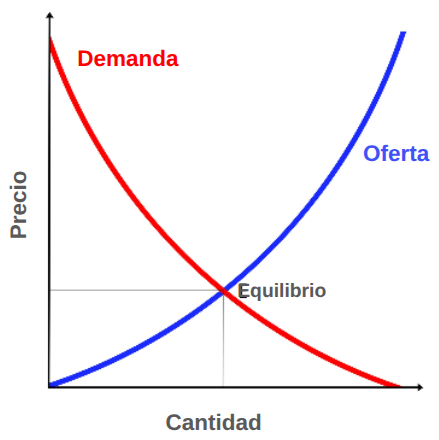
Prices are determined at the exact point where supply equals demand. They introduced both the concept of partial equilibrium (analyzing an isolated market) and that of general equilibrium (interconnection of all markets in the economy).
In neoclassical models (especially the general-equilibrium models of Walras, Arrow, and Debreu), one starts from very strong assumptions:
- All relevant information is available and known by all agents (or at least by a “planner” who could calculate it).
- Consumers’ preferences are given and stable.
- Technology and resources are given.
- Perfect competition exists (no one has market power).
- Time does not pass in a relevant way (it is a static model or one of instantaneous equilibrium).
Under these assumptions, the price system can, in theory, lead to a situation of general equilibrium in which resources are allocated in a Pareto-optimal manner: no one can improve his situation without worsening that of another. That is, an “optimal” allocation is reached in the static sense: everything is perfectly coordinated, there is no waste, there are no unexploited opportunities for gain, and prices reflect exactly social opportunity costs.
That is the ideal many neoclassical economists have in mind when they speak of “market efficiency.”
In that static world (frozen in time), the price mechanism reaches a point of perfect mathematical equilibrium where supply equals demand instantaneously. Resources are “optimally allocated” because the mathematical snapshot closes to perfection.
Mathematization of Economics:
They turned economics into a formalized science through the use of differential calculus. Concepts such as marginal cost, marginal revenue, and marginal productivity are modeled as mathematical functions in order to find optimal points of optimization (Marginal Cost = Marginal Revenue).
Main Thinkers
The neoclassical school was initially formed from three independent centers that coincided in time:
- Alfred Marshall (1842–1924): The great systematizer of the school and professor at Cambridge. In his work Principles of Economics (1890), he combined the marginal utility of demand with the production costs of supply, creating the famous graphs of crossed curves (the “Marshallian scissors”).
- Léon Walras (1834–1910): Leader of the Lausanne School, he was the pioneer in mathematically modeling General Equilibrium, attempting to demonstrate through a system of simultaneous equations how all markets in an economy equilibrate at the same time.
- William Stanley Jevons (1835–1882): One of the first to apply mathematical calculus strictly to consumer utility, affirming that economics is essentially a science of quantifiable pleasure and pain.
- Note on Carl Menger (1840–1921): Historically he is grouped in the original Marginalist Revolution. However, Menger rejected mathematization and static models, giving rise to the Austrian School, which branched off methodologically from the main neoclassical current.
Underlying philosophical vision
The neoclassicals are positivists and mechanists. They see the economy as a system of balanced forces (like Newtonian mechanics). The human being is an isolated rational maximizer (not an actor in time and uncertainty as in the Austrian School). History and institutions matter little; what counts is static equilibrium and universal laws. There is strong methodological individualism, but combined with an aggregative and mathematical approach that dilutes true individualism.
Main critiques
Austrian critiques (Mises, Hayek, Kirzner, Rothbard)
- Equilibrium vs. Process: The neoclassicals study a static and unreal state of equilibrium. Reality is dynamic and disequilibrated. The true engine is the entrepreneur (Israel Kirzner) who discovers opportunities under uncertainty, not the fictitious “Walrasian equilibrium.”
- Perfect information: Impossible. Hayek in “The Use of Knowledge in Society” (1945) shows that knowledge is dispersed, tacit, and changing; only the free market coordinates it through prices.
- Mathematical calculation: Mises and Hayek criticize the abuse of mathematics. Human action is not measurable like masses in physics (praxeology).
- Model failures: It ignores time, heterogeneous capital (Böhm-Bawerk), and the structure of production. The Austrian theory of the business cycle shows that “equilibria” forced by the central bank generate bubbles and crises.
- Loss of radical subjectivism: Although they accept subjective value, the neoclassicals “objectivize” it with curves and mathematical functions, betraying the true Subjectivism of Menger.
Other critiques
- Keynesians: Neoclassical equilibrium does not explain involuntary unemployment or macro crises (insufficient aggregate demand).
- Institutionalists and historicists: It ignores institutions, culture, and history (economics is not “ahistorical”).
- Modern (behavioral) critiques: Homo economicus is false; humans have cognitive biases (Kahneman, Thaler).
- Marxists and heterodox: It serves as an ideological justification of capitalism (though Austrians would say it is a lukewarm and defective defense).
Legacy
The Neoclassical School dominates current university teaching (microeconomics + neoclassical macro). However, from the Austrian perspective, it represents a partial advance (subjectivism of value) but also a regression by mathematizing and equilibrating what should be an analysis of the market process in real time. Mises summed it up: “Neoclassical economics is an economics without real human action.”
This article is part of the Basic Course on Libertarianism and the Austrian School of Economics-> Module 4: Main Schools of Economics
| Previous topic | Next related topic | |
|---|---|---|
| <- Classical school of economics | <---> | Austrian School of economics-> |
Last updated: 2026-05-16
| | | |
This site was written based on publicly available free articles from the internet.
The content of this site is available under the: Creative Commons Attribution 4.0 International (CC BY 4.0) license.
You can freely copy, redistribute and modify the material, as long as the source is mentioned: liberwiki.com