


Milton Friedman
This article is part of the Basic Course on Libertarianism and the Austrian School of Economics-> Module 4: Main Schools of Economics
Last updated: 2026-05-16
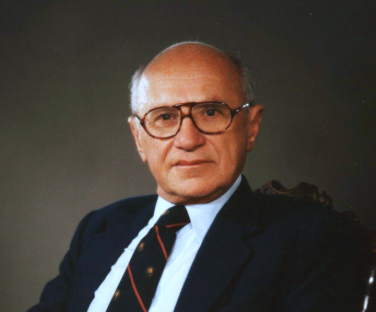
Life, work, and legacy
Milton Friedman (1912–2006) was one of the most influential, celebrated, and debated economists of the twentieth century. Principal exponent of the Chicago School of Economics and founder of monetarism, he devoted his academic career and public life to reviving faith in the free market, criticizing the interventionist policies of Keynesianism, and defending individual liberty against the growth of state power.
1. Life and Intellectual Trajectory
Milton Friedman was born in Brooklyn, New York, into a humble family of Jewish immigrants from Eastern Europe. Showing from a very young age a brilliant aptitude for mathematics, he completed his undergraduate studies at Rutgers University. He later earned a master’s degree at the University of Chicago (1933) and his Ph.D. at Columbia University (1946).
During the years of the Great Depression and the course of the Second World War, Friedman worked as a statistician and economist for various federal agencies of the U.S. government (associated with the New Deal and the design of wartime fiscal policy). This direct empirical experience with state bureaucracy decisively shaped his later skepticism toward centralized planning and government intervention.
In 1946 he returned to the University of Chicago, where he taught and researched for three decades. Together with intellectuals such as George Stigler, he consolidated the so-called Chicago School, a neoclassical macroeconomic current characterized by empirical rigor and a firm defense of free markets in an era when the Keynesian paradigm dominated almost completely academia and world economic policy.
In 1947 he took an active part, together with Friedrich Hayek, in founding the Mont Pèlerin Society, a key intellectual bastion for the preservation and diffusion of classical libertarianism. In 1976, the Swedish Academy awarded him the Nobel Prize in Economics for his research in the fields of consumption analysis, monetary history and theory, and the complexity of stabilization policies. After retiring from active teaching, he continued his work as a senior research fellow at the Hoover Institution of Stanford University until his death in San Francisco in 2006.
What is Monetarism?
- Simple definition: An economic theory developed mainly by Milton Friedman and Anna Schwartz (especially in their book A Monetary History of the United States, 1963) which holds that inflation and economic fluctuations are, ultimately, monetary phenomena.
- Central ideas:
- “Inflation is always and everywhere a monetary phenomenon” (Friedman’s famous phrase).
- The quantity of money in circulation (money supply) determines the general price level in the long run.
- It proposes a fixed monetary rule: the money supply should grow at a constant and predictable rate (for example, 3–5% per year, equal to the real growth of the economy), rather than allowing the central bank to act discretionarily.
- It rejects Keynesian fiscal policy (public deficits to stimulate) and prioritizes control of the quantity of money.
- Historical success: In the 1970s–80s it explained stagflation (inflation + unemployment), which Keynesianism could not explain. It influenced the policies of Reagan (U.S.), Thatcher (United Kingdom), and the creation of independent central banks.
Austrian critique (brief and direct):
The Austrians (Mises, Hayek, Rothbard) agree that inflation is monetary, but disagree radically on the cause and the solution:
- For the Austrians the problem is not only the quantity of money, but its asymmetric injection through bank credit (artificial credit expansion), which distorts the temporal structure of production (Austrian theory of the business cycle).
- A fixed monetary rule (monetarism) is still state intervention and generates cycles; the only coherent solution is free banking (private banks issuing money backed by gold or commodities) or, in Rothbard, 100% reserves.
- Friedman and the Chicago School see the cycle as a problem of “too much or too little” money; the Austrians see it as a problem of bad relative-price signals caused by the central bank.
In short: the Chicago School was (and remains in its descendants) the pragmatic-empirical libertarianism that won the political battle against Keynesianism in the 1980s, while monetarism was its macroeconomic tool. Both are allies of Austrian thought in the defense of the market, but they represent a more moderate and statistical version, not the radical praxeological and ethical tradition of Vienna.
2. Work and Main Academic Contributions
Friedman’s theoretical work completely transformed modern macroeconomics through his challenges to the orthodoxy of his time:
A. Monetarism and the Quantity Theory of Money
Friedman is unanimously recognized as the father of modern monetarism. He rescued and updated the old quantity theory of money, arguing that changes in the money supply have determining effects on production in the short run and on the general price level in the long run. His most celebrated maxim sums up this thought: "Inflation is always and everywhere a monetary phenomenon," generated solely by growth in the quantity of money in circulation faster than real production of goods and services.
In his monumental joint work with Anna Schwartz, A Monetary History of the United States, 1867–1960 (1963), he carried out an exhaustive historical analysis that showed that the Great Depression of the 1930s was not an intrinsic failure of capitalism (as the general consensus held), but the direct consequence of disastrous management by the Federal Reserve (Fed), which passively allowed the money stock to contract by a third, strangling the banking system and real economic activity.
B. The Permanent Income Hypothesis (1957)
Against John Maynard Keynes’s theory, which postulated that household consumption fluctuates directly with short-run current income, Friedman developed the Permanent Income Hypothesis. He demonstrated empirically that individuals’ consumption and investment decisions are guided by their long-run income expectations (their “permanent income”) and not by transitory gains or losses. This implied that temporary public-spending fiscal stimuli proposed by governments had a much smaller and less predictable impact on real economic recovery than was assumed.
C. The Natural Rate of Unemployment and the Critique of the Phillips Curve
In the 1960s, economic planners assumed that there existed a stable and permanent trade-off between inflation and unemployment (the traditional Phillips Curve): to lower unemployment, it was enough to accept a bit more inflation through expansionary policies. Friedman (in parallel with Edmund Phelps) challenged this by introducing the concept of the Natural Rate of Unemployment and the role of inflation expectations.
He held that government attempts to force unemployment below its structural rate would only achieve ever-higher inflation in the long run, as workers and entrepreneurs adjusted their price expectations. This theoretical prediction was tragically confirmed in the 1970s with the arrival of stagflation (high unemployment combined with high inflation), a phenomenon that the traditional Keynesian framework considered theoretically impossible and that precipitated the decline of its academic hegemony.
D. Political Philosophy and Public Outreach
Friedman possessed a communicative capacity unusual in the scientific sphere. In works aimed at a mass audience such as Capitalism and Freedom (1962) and Free to Choose (1980) (the latter accompanied by a successful television documentary series on the public network PBS, written together with his wife Rose Friedman), he translated complex macroeconomic concepts into a common-sense narrative based on the benefits of voluntary cooperation and distrust of state coercion.
3. Public Policy Proposals and Legacy
Milton Friedman’s legacy transcended university walls and directly shaped the economic architecture of the late twentieth century. Among his most disruptive proposals, many of which passed from academic utopia to institutional reality, the following stand out:
- End of military conscription: Friedman was a key member of the Gates Commission (1970). His economic and moral argument for the superiority of a professional volunteer army over the “forced labor” of the draft was decisive in abolishing compulsory military service in the United States after the Vietnam War.
- Flexible exchange rates: He successfully defended abandoning the fixed exchange-rate system that emerged from Bretton Woods, paving the way for the current model of floating currencies regulated by market forces.
- Education vouchers (school voucher): He proposed decentralizing education through a system in which the State finances demand (via a coupon delivered directly to parents) and not supply (public schools), allowing families to choose freely among public and private schools in an environment of healthy school competition.
- Negative Income Tax: He designed a mechanism of direct subsidy for the lowest incomes through the tax system. If a citizen earned less than a minimum threshold, the State would pay him a proportion of the difference instead of collecting taxes. This proposal inspired current tax-credit programs (such as the Earned Income Tax Credit in the U.S.) and is a direct technical antecedent of the modern debate on basic income.
- Deregulation and Privatization: His tireless defense of privatizing state monopolies and eliminating price controls (such as the minimum wage or rent controls) served as the ideological substrate for the economic reforms of Ronald Reagan in the U.S. and Margaret Thatcher in the United Kingdom during the 1980s.
Main critiques of his ideas and his response
Milton Friedman’s revolutionary theses on monetarism, the free market, and the limitation of state power generated heated debates throughout the second half of the twentieth century. Standing at the center of the macroeconomic stage, he received crossfire from the Keynesian and social-democratic left, as well as from the more radical liberal right, such as the Austrian School.
1. Macroeconomic and Keynesian Critiques
The alleged instability of the velocity of money
- The critique: Keynesian-leaning economists argued that Friedman’s central proposal — the “monetary rule,” which required central banks to increase the money supply at a fixed and constant rate — was dangerously rigid. They held that the velocity of circulation of money is not stable (especially in times of crisis or “liquidity traps,” where people prefer to hoard cash), so a rigid emission rule could cause severe recessions or unforeseen inflationary spirals.
- Friedman’s response: After analyzing nearly a century of statistical data in his work with Anna Schwartz, Friedman showed that the velocity of money fluctuated in a predictable way in the long run in relation to permanent income. He argued that the real historical danger was not the rigidity of a rule, but the discretion of central bankers. For him, governments’ attempts to “fine-tune the economy” through constant manipulations usually worsened cycles because of inevitable time lags (between detecting the problem, implementing the measure, and the measure taking effect).
2. Epistemological Critiques and Those of the Austrian School
Methodological positivism and acceptance of the Central Bank
- The critique: Thinkers of the Austrian School (such as Murray Rothbard) leveled harsh critiques against Friedman on two fronts:
- Methodology: They criticized his positivist and empirical approach. For the Austrians, economics is governed by a priori logical axioms (praxeology); they considered that trying to measure human behavior through statistical aggregates or macroeconomic equations stripped economics of its human essence.
-
The monopoly of money: They reproached him for not defending the total abolition of the Central Bank or a return to the gold standard. They considered that Friedman’s proposal to keep a Federal Reserve coercively controlling fiduciary money was still a form of centralized planning that would cause distortions in relative prices (Cantillon Effect).
-
Friedman’s response: Friedman firmly defended the traditional scientific method: he held that the validity of an economic theory does not depend on the “realism” of its starting assumptions, but on its predictive capacity and its confrontation with empirical evidence. Regarding central banking, Friedman considered himself a pragmatist. Although theoretically he sympathized with the idea of a free market in currencies, he believed that dissolving the Federal Reserve was a political utopia unviable in the short run; therefore, tying the Central Bank’s hands with an automatic rule was the most realistic and efficient solution to prevent bureaucrats from destroying the value of the currency.
3. Political and Ethical Critiques
The Chile controversy and the Pinochet dictatorship
- The critique: He was accused of moral and ideological complicity with Augusto Pinochet’s military dictatorship in Chile. This critique intensified because of a brief visit he made to the country in 1975, where he met with the dictator, and because the main Chilean economic reformers (the Chicago Boys) were his direct disciples from the University of Chicago. His detractors claimed that the radical free-market model could only be imposed through violent state repression.
- Friedman’s response: Friedman always maintained that his involvement in Chile was strictly academic, technical, and equivalent to neutral medical assistance: “A physician who gives technical advice on how to combat an epidemic to a dictatorial government is not approving the dictatorship.” In addition, he developed a deep political-philosophy argument in his book Capitalism and Freedom: he held that economic liberty is a necessary but not sufficient condition for political liberty. He argued prophetically that free-market reforms would decentralize power, create a middle class independent of the State, and end up undermining the dictatorship’s own power base, forcing the return of democracy (a phenomenon he dubbed “the Miracle of Chile”).
4. Social and Corporate Critiques
The amorality of the market and corporate social responsibility
- The critique: In 1970, Friedman published a celebrated article in The New York Times in which he stated that "the social responsibility of business is to increase its profits." Philosophers, unions, and social-democratic sectors accused him of promoting a savage, selfish, and dehumanized capitalism that deliberately ignored the welfare of workers, local communities, and environmental impact.
- Friedman’s response: Friedman argued that his position was, in reality, the only one compatible with a truly democratic and free society. He explained that the managers of a corporation are employees of the shareholders (the legitimate owners of the property). If a manager decides to spend the firm’s money on social causes that do not maximize profit, he is acting illegitimately: he is levying a unilateral “tax” on the shareholders (or on consumers via higher prices) and arbitrarily deciding how to redistribute that wealth, a legislative function that belongs only to representatives elected by citizens in the State. For Friedman, the true social responsibility of individuals is exercised in the private sphere through voluntary philanthropy, not by using other people’s money through corporations.
Summary Table: Ideological Clashes
| Type of Critique | Principal Critic | Argument against | Friedman’s Defense |
|---|---|---|---|
| Macroeconomic | Keynesians | The velocity of money is unstable; fixed rules cause crises. | Discretionary government interventions are what aggravate economic cycles because of time lags. |
| Methodological | Austrian School | The use of macroeconomic data and statistics dehumanizes economics and legitimizes the Central Bank. | Theories should be judged by their predictive success. Controlling emission through a rule is the most pragmatic solution. |
| Political / Ethical | Political Left | His technical advice to Chile linked the free market with the oppression of a dictatorship. | His advice was purely technical. Economic openness empowers citizens and ends up destroying political tyranny. |
| Social | Social Democracy | Saying that firms should only seek profits promotes greed and harms society. | Executives have no legitimacy to spend shareholders’ money on social ends. The free market allocates resources optimally. |
Summary of his impact
Milton Friedman permanently changed the global understanding of economic cycles, inflation, and the limits of state intervention. His genius lay in combining the most rigorous econometric analysis with a magnetic capacity for communication, bringing the ideas of classical libertarianism down from pure theory and turning them into the engine of the great institutional reforms of the modern contemporary world.
This article is part of the Basic Course on Libertarianism and the Austrian School of Economics-> Module 4: Main Schools of Economics
| Previous topic | Next related topic | |
|---|---|---|
| <- Robert Nozick (1938-2002) (He was a philosopher, not an economist) | <---> | Subjective theory of value -> |
Last updated: 2026-05-16
| | | |
This site was written based on publicly available free articles from the internet.
The content of this site is available under the: Creative Commons Attribution 4.0 International (CC BY 4.0) license.
You can freely copy, redistribute and modify the material, as long as the source is mentioned: liberwiki.com