


Quantity theory of money
This article is part of the Basic Course on Libertarianism and the Austrian School of Economics-> Module 5: Austrian Economics and Free Market
Last updated: 2026-04-30
Continued from -> Inflation.
Definition
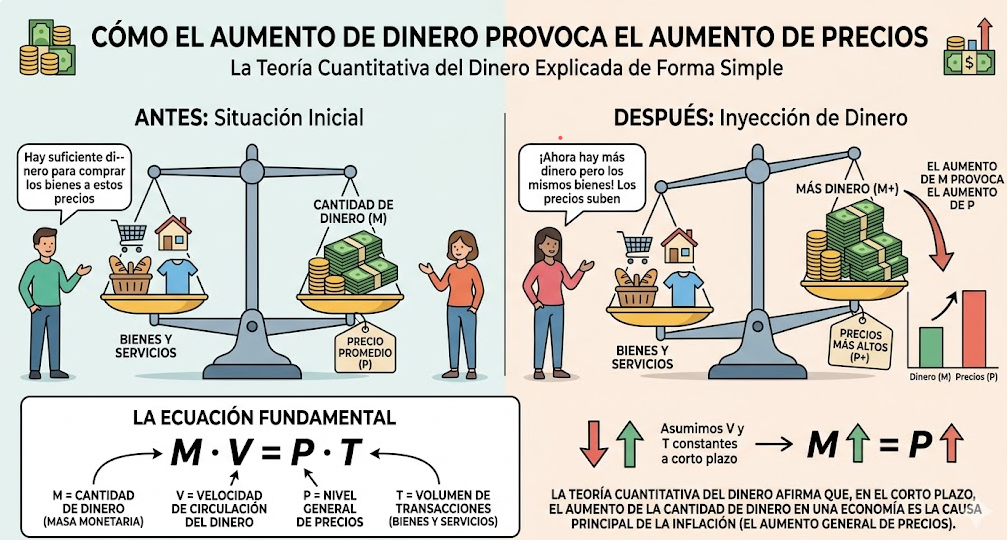
The quantity theory of money establishes that there exists a direct relationship between the quantity of money in circulation and the general price level, postulating that an excessive increase in the money supply generates inflation. Its fundamental premise is that if real production is stable, more money chasing the same goods raises prices.
Assuming that real production and the velocity of circulation of money remain constant, if you double the quantity of money, you (approximately) double prices. (Production is the same; the quantity of money doubled)
View of the different schools
1. The Basic Equation (Classical and Monetarist View)
The best-known form of this theory is expressed in Irving Fisher’s equation of exchange: M · V = P · Y
- M: Money stock (quantity of money).
- V: Velocity of circulation (how many times money changes hands).
- P: Price level.
- Y (or T): Real production or transactions of goods and services.
For the classicals and monetarists (such as Milton Friedman), if V and Y remain stable, an increase in the quantity of money (M) translates directly into a proportional increase in prices (P). In this view, money is “neutral”: it only affects nominal prices, not real production in the long run.
2. The View of the Austrian School (Critical and Nuanced)
For the Austrians (Mises, Rothbard), traditional QTM is too simplistic because it ignores microeconomic effects. Their key points are:
- Money is NOT neutral: New money does not arrive to everyone at once. It enters at specific points (banks, the state) and expands gradually.
- Cantillon Effect: Those who first receive the money can buy goods at low prices. When the money reaches the rest of the population, prices have already risen. This generates a regressive redistribution of wealth.
- Distortion of relative prices: Not all prices rise equally or at the same time. This confuses entrepreneurs and alters the structure of production (which leads to economic crises).
3. The Keynesian View
Keynes questioned the stability of the components of the equation:
- Instability of V: In times of crisis, people prefer to “hoard” money out of precaution (liquidity preference), so the velocity of money falls.
- Effect on production (Y): Keynes argued that, if there are idle resources (unemployment), an increase in M could increase production (Y) instead of prices (P). That is why he defended monetary expansion to reactivate the economy.
What is Monetarism?
- Simple definition: An economic theory developed mainly by Milton Friedman and Anna Schwartz (especially in their book A Monetary History of the United States, 1963) which holds that inflation and economic fluctuations are, ultimately, monetary phenomena.
- Central ideas:
- “Inflation is always and everywhere a monetary phenomenon” (Friedman’s famous phrase).
- The quantity of money in circulation (money supply) determines the general price level in the long run.
- It proposes a fixed monetary rule: the money supply should grow at a constant and predictable rate (for example, 3–5% per year, equal to the real growth of the economy), rather than allowing the central bank to act discretionarily.
- It rejects Keynesian fiscal policy (public deficits to stimulate) and prioritizes control of the quantity of money.
- Historical success: In the 1970s–80s it explained stagflation (inflation + unemployment), which Keynesianism could not explain. It influenced the policies of Reagan (U.S.), Thatcher (United Kingdom), and the creation of independent central banks.
Austrian critique (brief and direct):
The Austrians (Mises, Hayek, Rothbard) agree that inflation is monetary, but disagree radically on the cause and the solution:
- For the Austrians the problem is not only the quantity of money, but its asymmetric injection through bank credit (artificial credit expansion), which distorts the temporal structure of production (Austrian theory of the business cycle).
- A fixed monetary rule (monetarism) is still state intervention and generates cycles; the only coherent solution is free banking (private banks issuing money backed by gold or commodities) or, in Rothbard, 100% reserves.
- Friedman and the Chicago School see the cycle as a problem of “too much or too little” money; the Austrians see it as a problem of bad relative-price signals caused by the central bank.
In short: the Chicago School was (and remains in its descendants) the pragmatic-empirical libertarianism that won the political battle against Keynesianism in the 1980s, while monetarism was its macroeconomic tool. Both are allies of Austrian thought in the defense of the market, but they represent a more moderate and statistical version, not the radical praxeological and ethical tradition of Vienna.
Comparative Table of Interpretations
| Aspect | Monetarist / Classical | Keynesian | Austrian |
|---|---|---|---|
| M–P relation | Proportional and direct. | Indirect; depends on liquidity. | Not proportional; distorts prices. |
| Neutrality | Money is neutral in the long run. | Money can affect production. | Money is never neutral. |
| Focus | Macroeconomic aggregates. | Demand management. | Structure of production and relative prices. |
| Inflation | Strictly monetary phenomenon. | Can be caused by excess demand. | Is the expansion of the money stock itself. |
Conclusion: While monetarists see QTM as a rule for controlling inflation and Keynesians as a tool for growth, the Austrian School uses it to warn how the creation of money deforms the real economy and causes the boom-and-bust business cycle.
This article is part of the Basic Course on Libertarianism and the Austrian School of Economics-> Module 5: Austrian Economics and Free Market
| Previous topic | Next related topic | |
|---|---|---|
| <- The gold standard | <---> | Inflation -> |
Last updated: 2026-04-24
| | | |
This site was written based on publicly available free articles from the internet.
The content of this site is available under the: Creative Commons Attribution 4.0 International (CC BY 4.0) license.
You can freely copy, redistribute and modify the material, as long as the source is mentioned: liberwiki.com