Mercantilism Colonialism and Slavery
This article is part of the Basic Liberalism Course -> Module 7: Distortions of the Free Market
Last updated: 2026-06-03
It is required to have read the following articles first:
In this article we combine the 3 concepts: Mercantilism, Colonialism and Slavery (transatlantic) since they are very related, one is a consequence of the other and vice versa.
Mercantilism
The mercantilism was the dominant set of economic ideas and policies in Europe, of the absolutist States (Spain, Portugal, England, France, Holland), between the 16th and mid-18th centuries (approximately 1500-1750).
It was not a formal “school” with a single central theorist, but a pragmatic set of practices and recommendations directed at absolutist monarchs to strengthen the power of the emerging Nation-State.
Adam Smith baptized it pejoratively as the “mercantile system” in Book IV of The Wealth of Nations, and made it his main target of criticism.
Main ideas of mercantilism
- Objectives: accumulate precious metals, protect national industry with tariffs, prohibitions and subsidies, and create monopolies.
Wealth = precious metals (Bullionism)
-
The prosperity of a nation was measured by the amount of gold and silver that the State or the kingdom possessed.
-
Metallic money was not just a medium of exchange, but the very form of wealth.
Favorable balance of trade
-
To accumulate metals, it was essential to export more than was imported.
-
A “positive trade balance” brought gold to the country; a negative one took it out.
-
World trade was seen as a zero-sum game: what one wins, the other loses.
-
The State must intervene strongly to achieve a favorable trade balance (export more than it imports).
Intense protectionism and state regulation
-
High tariffs and prohibitions on imports of finished manufactures.
-
Subsidies to exports.
-
Royal monopolies granted to privileged companies (such as the British East India Company or the Indian companies).
-
Restrictions on the export of raw materials (so that national industry could process them).
-
Population control: encourage demographic growth to have cheap and abundant labor.
-
Navigation laws (Navigation Acts in England) that required transporting goods in own ships.
Colonialism as an economic instrument
-
The colonies had to supply cheap raw materials to the metropolis (the colonizing country) and buy exclusively its finished manufactures. The colonies were not allowed to compete industrially with the mother country.
-
Colonialism is a direct consequence of Mercantilist ideas.
Summary
-
Mercantilism was an economic nationalism at the service of state power. The economy was subordinated to State policy.
-
Mercantilism: wealth = gold + trade balance + strong State.
Colonialism
Colonialism is the historical, political and economic system by which a power (normally a nation-state) exercises direct and prolonged dominion over territories and populations outside its natural borders, with the main purpose of extracting resources, controlling trade routes and establishing settlements of its own population.
It was a direct consequence of mercantilist ideas.
Precise definition and constituent elements
Historically, colonialism is characterized by four central features:
-
Transferred political sovereignty: The metropolis (the colonizing country) assumes legislative, judicial and military control of the colonized territory, displacing or subordinating local authorities.
-
Settlement or exploitation: In some cases there is a massive migration of settlers from the metropolis (as in North America, Australia or the Río de la Plata); in others, the extraction of resources and labor predominates with a reduced administrative elite (as in much of Africa and Asia).
-
Systematic economic exploitation: The colony is treated as a source of cheap raw materials and a captive market for the manufactured products of the metropolis, normally under a regime of commercial monopoly (mercantilism).
-
Ideological justification: It is legitimized through narratives of cultural, religious or “civilizing mission” superiority (the White Man’s Burden, Catholic evangelization, the French “republican mission”, etc.).
Errors on which Colonialism is based
Mercantilism was structured on two great theoretical fallacies that we already defined before:
-
Bullionism
-
The illusion of zero sum (Montaigne's fallacy)
Consequences of these ideas:
If global wealth is fixed and measured in gold, peaceful and voluntary international trade ceases to be a positive sum game. To guarantee a constant trade surplus (sell a lot and buy little), the State required absolute control of foreign markets.
Colonialism was the perfect political-military tool to operationalize this premise: the metropolis invaded and annexed peripheral territories to turn them into exclusive suppliers of cheap raw materials and, simultaneously, into captive markets forced to buy its expensive manufactures.
The Colonies
Mercantilism needed colonies to function fully. The colonies were not seen as societies with their own right to develop, but as possessions designed to serve the metropolis. Their function was threefold:
-
Providers of cheap raw materials (silver, gold, sugar, tobacco, cotton, spices, wood).
-
Slavery for the manufactured products of the metropolis (they could not buy from other countries or industrialize).
-
Source of state power: more colonies = more wealth = more military power against rivals.
This generated the famous triangular trade (especially in the British and French Atlantic):
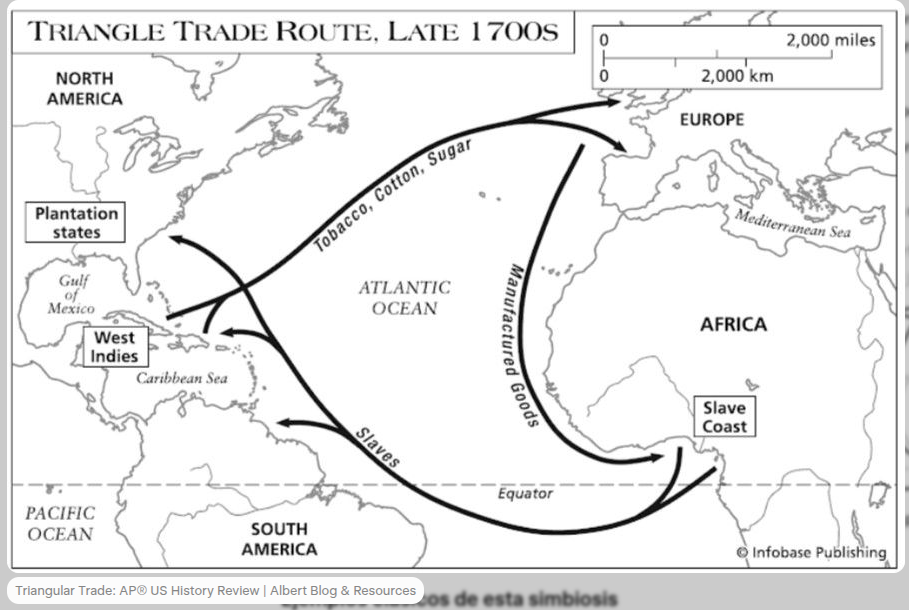
Europe sent manufactures → Africa sent slaves → America sent raw materials (sugar, tobacco, cotton) → and the cycle continued, always controlled by the metropolis.
Classic examples of this symbiosis
Spain:
The purest system. The Casa de Contratación of Seville and the fleet system controlled all trade with America. The silver from Potosí and Zacatecas flowed to Spain… and from there quickly went out to other countries because Spain produced almost nothing competitive. Despite the enormous extractive wealth, Spain entered relative decline.
Great Britain:
-
The Navigation Acts (1651 onwards) were pure mercantilist legislation. The American colonies could only export and import in British ships and almost exclusively with England. This generated great resentment and was an important cause of the American Revolution (1776).
-
Privileged companies: The British East India Company, the Dutch VOC and the Portuguese were private companies with monopolies granted by the State, their own armies and rights of conquest. Perfect example of crony capitalism on a global scale.
Perspective from Austrian economics
Classical colonialism is a manifestation of state mercantilism and interventionism, not free market capitalism:
-
It was a system of monopolistic privileges granted by the State (East India Company, Casa de Contratación of Seville, etc.).
-
It generated price distortions and massive corruption, instead of a genuine international division of labor based on private property and voluntary exchange.
-
Ludwig von Mises and Murray Rothbard argued that true classical liberalism (free trade, non-intervention) would have been much more beneficial for the colonies than mercantilist colonialism. Free trade allows each region to specialize according to its theory of comparative advantage without the need for conquest.
Summary:
-
Colonialism was not a “capitalist” adventure, but a mercantilist-state enterprise, an economic nationalism, state capitalism or political capitalism.
-
It was economic nationalism at the international level: the State granted monopolies and privileges to connected companies and groups, who in turn financed and legitimized the State.
-
The link between colonialism and mercantilism is one of the closest and most revealing in economic history. We can practically say that modern European colonialism (16th-18th centuries) was, to a large extent, the territorial and practical expression of mercantilism.
This explains why many Austrian and revisionist economic historians maintain that the great enrichment of the West did not come mainly from colonial plunder, but from the institutions of private property and trade that developed in spite of mercantilism, especially in the Netherlands and England from the 18th century onwards.
Slavery
Slavery: a historical phenomenon prior to mercantilism
Slavery existed in practically all complex societies: Mesopotamia, Egypt, Greece, Rome, the Islamic world, pre-colonial Africa and pre-Columbian American civilizations. It was based on the capture of prisoners of war, debts, punishments or births into servitude.
Philosophically, it contradicts the principle of self-ownership (self-ownership), which the Austrian School (Mises, Rothbard) considers axiomatic: the human being is the owner of his body and his work.
Biologically, it goes against the voluntary cooperation that characterizes human action and that allowed the development of prosperous societies.
However, the form that interests us most here —transatlantic slavery— acquired an industrial scale thanks to European mercantilism.
The intimate relationship between slavery and mercantilism: triangular trade
Mercantilism needed colonies and these needed cheap and coercive labor to produce export goods (sugar, tobacco, cotton, coffee, indigo) that generated the trade surplus.
The American indigenous population collapsed due to diseases and exploitation, so there was massive recourse to African slaves.
As explained above, this system was organized through triangular trade (or triangular trade):
-
Europe → Africa: ships loaded with manufactures (fabrics, weapons, alcohol, tools) that were exchanged for slaves captured by African kingdoms or local traffickers.
-
Africa → Americas: the infamous Middle Passage, where slaves were treated as merchandise (high mortality).
-
Americas → Europe: raw materials produced on slave plantations that were sold in Europe, closing the cycle and generating profits.
This circuit was not a "free market" or "pure capitalism", but a system highly regulated by state monopolies (such as the British Royal African Company or the Spanish Casa de Contratación) and by mercantilist laws that prohibited the colonies from trading freely.
The slaves were considered a strategic input to maximize exports and minimize imports of the metropolis. Countries like England, France and Portugal built much of their naval and commercial power on this model.
Mercantilism made slavery a state economic pillar.
Mercantilism did not “invent” slavery, but industrialized it and integrated it into the heart of its colonial-statist project. This perfectly illustrates how state intervention and the rejection of private property and individual freedom generate human suffering and economic distortions that only the spontaneous order of the free market can overcome.
True wealth is productive capacity (goods and services), not accumulated gold.
Adam Smith's main criticism
Smith destroyed the ideas of mercantilism with several key arguments:
-
The true wealth of nations is not gold, but the productive capacity of the people:
- goods and services that satisfy human needs (the famous phrase: “consumption is the sole end and purpose of all production”).
-
Trade is not a zero-sum game.
- Both parties win when they exchange voluntarily according to their advantage (although Smith did not yet use the term “Theory of Comparative Advantage”, which Ricardo would develop).
-
The “invisible hand” and self-interest well channeled
- generate a spontaneous order much more efficient than any state planning.
-
Restrictions on trade benefit privileged producers and merchants at the expense of consumers and the nation as a whole.
- Smith was especially harsh on merchants: “they never meet without the conversation ending in a conspiracy against the public”.
Smith dedicates Book IV entirely to dismantling the “mercantile system” and, within it, colonialism as its most absurd and costly expression.
-
The British colonial empire (and others) was created “only to breed a nation of clients” forced to buy at monopolistic prices.
-
The cost of defending and maintaining colonies fell on British taxpayers, while the benefits went to a handful of monopolists.
-
Free trade would make colonies unnecessary: wealth arises from the division of labor and voluntary exchange, not from conquering territories.
According to Adam Smith: mercantilist colonialism is living proof that interventionism impoverishes and generates suffering.
This article is part of the Basic Liberalism Course -> Module 7: Distortions of the Free Market
| Previous Topic | Next topic | |
|---|---|---|
| <- Montaigne's Fallacy | <--> | Low State Intervention-> |
Last updated: 2026-06-03
| |
|  |
| |
|