


Definition of Libertarianism
Categories: Home -> Libertarianism
This article is part of the Basic Course on Libertarianism and the Austrian School of Economics-> Module 2: Libertarianism and its ethical foundations
Last updated: 2026-05-02
What is libertarianism?
Libertarianism is the unrestricted respect for the life project of others, based on the “non-aggression principle,” the right to life, liberty, and private property.
Definition given by Alberto Benegas Lynch (h). This definition condenses the whole of the libertarian idea; if you act this way you can be sure you are acting in a libertarian manner—it is quite simple.
- Live and let live.
- Let no one!—no person (rich or powerful), no company (or multinational), no state or government—take your life, enslave you in any form, or steal the fruit of your work.
- In libertarianism EVERYTHING IS A VOLUNTARY TRANSACTION BETWEEN 2 PARTIES. Without threats, without imposition by force, only free and voluntary decisions.
- You begin to lose your rights when you aggress against the life, liberty, and private property of others.
Libertarianism is a political doctrine about the limits of power, rights, and the organization of coexistence, about how the power of the State should be organized.
Names attributed to libertarianism
Libertarianism, libertarianism, libertarian, minarchism, anarcho-capitalism, classical liberal, etc. What does each one mean?
The original name was libertarianism (19th century), and it was a name that the U.S. left stole (so to speak) at the beginning of the 20th century.
That is how in the U.S. the term libertarian was born to mean something else, and to differentiate (in English) liberal from libertarian; one must keep in mind that in the U.S. “liberals” are of the left and have nothing to do with libertarianism.
It is not so in the rest of the world, where the words libertarian, liberal, libertarianism, libertarianism mean practically the same thing; all are grouped under the liberal or libertarian ideology.
However, within the libertarian ideology itself there are different branches, some more radical and others more conservative. We summarize them below, from most radical to most conservative:
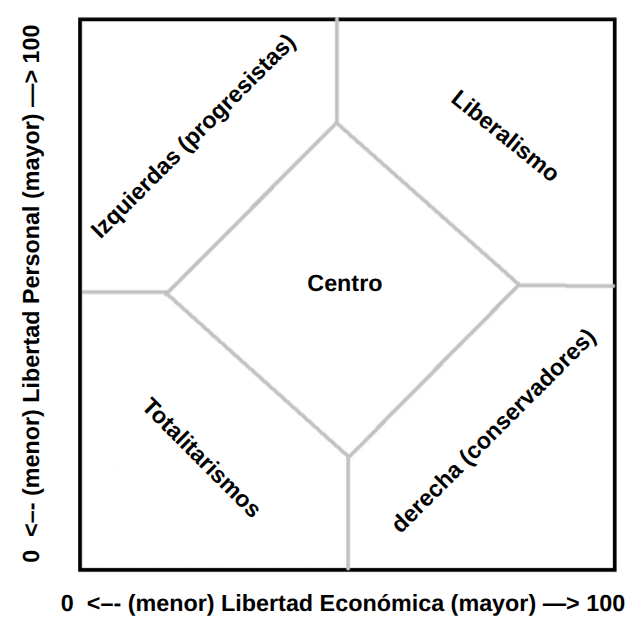
Explanation in a diagram
David Nolan was an American activist and politician who created this diagram in 1969. The diagram shows where libertarianism and the other political ideologies are positioned. As can be seen, libertarianism is at the upper-right tip, and it is the option that offers the most personal and economic freedom.
Branches of each ideology
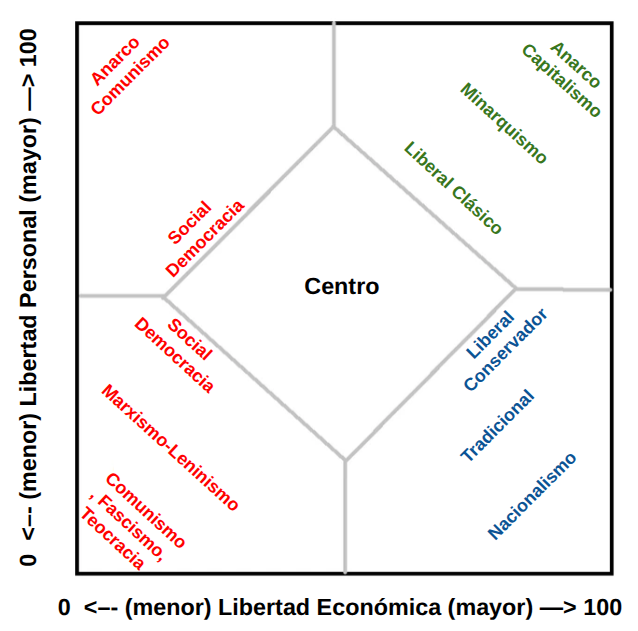
- Under totalitarianisms we have: Communism, Fascism (or Extreme Nationalism), Religious Theocracy
- Under the right we have, from greater to lesser freedom: Liberal-Conservatism, Traditional Conservative, Nationalism.
- Under the left we have, from greater to lesser freedom: Social Democracy, Marxism-Leninism, Anarcho-Communism (greater personal freedom, zero economic freedom)
- Under libertarianism, we explain them next
Branches of libertarianism
1. Anarcho-capitalism
The most radical ideology, anarcho-capitalism is a philosophy that defends the total abolition of the State and the organization of society through free markets, private property, and voluntary contracts.
It proposes that all functions traditionally associated with the State (security, justice, infrastructure) be provided by private firms in a competitive market.
Thinkers of this current were/are: Murray Rothbard, David Friedman.
Main characteristics:
- Absence of the State: There is no government; everything is resolved through voluntary agreements and markets. Taxes do not exist.
- Private property: It is the fundamental pillar. Everything, from roads to courts, can be privatized.
- Individual liberty: Maximum individual liberty, so long as the property or rights of others are not violated.
-
Non-aggression: Central principle that prohibits the use of force, except in defense of oneself or of property.
-
Practical example:
- Everything the State offers can be replaced by many insurance companies, and citizens are free to contract those of best renown.
- The police and armed forces would be replaced by private security agencies hired by individuals or communities.
- Education and health would also be private (in Argentina this model has existed for years)
- There would be hundreds of insurance companies offering insurance for: disability, retirement, disability before birth, etc. In Argentina private retirement was successful when it existed under the name AFJP.
- Justice would also be private, in which several companies could issue a verdict; the citizen can choose the justice company with the most renown. In these cases justice would be extremely fast and effective.
- Taxes would be ZERO; taxes do not exist
2. Minarchism
The term “minarchism” arises from a kind of joke among “anarchist” and “anarcho-capitalist” theorists; it is a combination of the words mini and anarchism, that is, neither “anarchism” nor “classical libertarianism,” a “near” anarchism.
Minarchism defends a minimal State, limited exclusively to essential functions in which it is indeed strong: Justice, Security (internal), and Defense (external).
Minarchism protects individual rights (life, liberty, property) through the police (inside the country), the courts, and military defense (against foreigners).
Everything else must be handled by the private sector (especially free competition among insurance companies). Some thinkers of this branch were: Robert Nozick, Ayn Rand.
Main characteristics:
- Limited State: A government exists, but only to guarantee security, justice, and defense against external aggressions. Taxes are extremely low (ideally less than 10% in total).
- Private property and markets: Strong emphasis on the free market, but with a State that acts as arbiter to resolve disputes.
- Individual liberty: Promotes individual liberty, but accepts certain state coercion (minimal taxes) to finance basic functions.
- Practical example: A minarchist government could maintain an army and a judicial system, but would not intervene in education, health, or economic regulation, unless they affect the life, liberty, and property of citizens.
3. Classical libertarianism
Libertarianism (in its classical sense) defends individual liberty, the free market, the rule of law, and limited government, but not necessarily minimal.
Unlike anarcho-capitalism and minarchism, classical libertarianism can accept a State with broader roles, such as providing public goods or regulating certain aspects of the economy, so long as liberty is preserved.
Some thinkers of this branch: John Locke, Adam Smith, Friedrich Hayek.
Main characteristics:
- Moderate State: Accepts a government with broader functions than minarchism (e.g., public education, infrastructure, limited regulation). Taxes are not low, since the state must be economically supported.
- Individual liberty and markets: Defends personal liberty and capitalism, but can tolerate state interventions to correct the market or guarantee equality of opportunity.
- Rule of law: Emphasis on clear and just laws that protect individual rights.
- Practical example: A liberal government could finance public schools or regulate monopolies, a mostly free market, and would try to lower taxes to their minimum expression, though it would be difficult because the state has to be maintained.
Comparative table
| Aspect | Anarcho-capitalism | Minarchism | Libertarianism (classical) |
|---|---|---|---|
| Role of the State | Null; everything privatized. | Minimal (security, justice, defense). | Moderate (may include public goods). |
| Taxes | Do not exist. | Minimal, only for essential functions. | Moderate, to finance public goods. |
| Individual liberty | Maximum, without state coercion. | High, with minimal state coercion. | High, but with possible state intervention. |
| Private property | Absolute; everything is privatizable. | Central, protected by the State. | Central, but with possible regulation. |
| Services provided by the State | None | Security, Justice | Most |
Important
In practice, anarcho-capitalism is theoretical, since there are no pure historical examples; it has never been carried out so far. Minarchism is also more an idea than a reality, although some countries with small governments (such as Switzerland in certain respects) come close. Classical libertarianism has influenced systems such as those of the United States or the United Kingdom in their origins.
Completing the Nolan diagram with the branches named
Note:
- Social democracy appears twice because it is large in the center-left, and sometimes tends to give more or less individual freedom.
-
Fascism:
- Although it differs from communism in rejecting the idea of “class struggle” and replacing it with “nationalism,” it does not seek the total abolition of property, but its total control by the State. In these senses, it nullifies people’s individual and economic liberty.
- For Austrians, the relevant axis is not left–right but interventionism vs. free market. Fascism, Nazism, social democracy, and communism are variants of statist collectivism. The difference is one of degree and rhetoric.
This article is part of the Basic Course on Libertarianism and the Austrian School of Economics-> Module 2: Libertarianism and its ethical foundations
| Previous topic | Next topic | |
|---|---|---|
| <-Collectivism and Contempt for Human Intelligence | <--> | Liberal Ethical Currents-> |
Categories: Home -> Libertarianism
Last updated: 2025-11-13
| | | |
This site was written based on publicly available free articles from the internet.
The content of this site is available under the: Creative Commons Attribution 4.0 International (CC BY 4.0) license.
You can freely copy, redistribute and modify the material, as long as the source is mentioned: liberwiki.com