


Frédéric Bastiat
Last updated: 2026-04-22
This article is part of the Basic Course on Libertarianism and the Austrian School of Economics-> Module 4: Main Schools of Economics
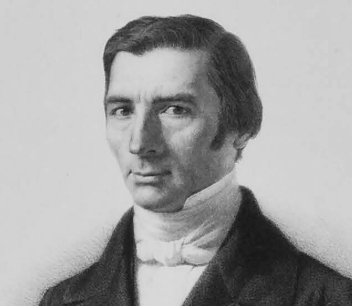
Frédéric Bastiat (1801–1850) was a French economist, writer, journalist, and politician, one of the greatest defenders of classical libertarianism and the free market in the nineteenth century. He was born in Bayonne (near the Spanish border), was orphaned young, and trained in the family business, where he directly observed the damages of protectionism (tariffs and trade restrictions that impoverished entire regions).
Bastiat was not a university academic, but a practical thinker who combined observation of reality with an extraordinary ability to explain complex economic ideas in a clear, ingenious, and satirical way. Influenced by Adam Smith, Jean-Baptiste Say, and the Physiocrats, he became an agitator for free trade (he was called “the French Cobden,” in reference to the British anti–Corn Law leader).
He founded the Free Trade Association in France and edited the newspaper Le Libre-Échange. In 1848 he was elected a deputy in the National Assembly during the Second Republic, where he fought nascent socialism. He died young (at 49) in Rome, probably of tuberculosis.
His most important works include:
- Economic Sophisms (1845–1848): a series of satirical articles against protectionism and interventionist fallacies.
- The Law (1850): his most famous essay on the nature and limits of law.
- That Which Is Seen and That Which Is Not Seen (1850): where he develops the famous parable of the broken window.
- Economic Harmonies (1850, incomplete because of his death): his most ambitious theoretical work.
Main ideas
Bastiat is considered a direct precursor of the Austrian School of economics for his emphasis on human action, subjective value, the spontaneous order of the market, and the critique of interventionism. His central ideas revolve around the social harmony that arises from liberty, provided that the State limits itself to its legitimate role.
-
The Law and Plunder
- In The Law, Bastiat argues that the purpose of law is to protect the life, liberty, and property of individuals (natural rights prior to the State). When the law is perverted, it becomes an instrument of legal plunder: the State uses force to strip some (producers) for the benefit of others (interest groups, classes, or “utopians”).
- He distinguishes between illegal plunder (common theft) and legal plunder (protectionism, subsidies, socialist redistribution).
- The celebrated phrase: “The State is the great fiction by which everyone tries to live at the expense of everyone else.”
- This idea anticipates public choice theory and the Austrian critique of the State as an agent of coercive redistribution.
-
Economic Harmony
The free market does not generate conflict of interests (as socialists believed), but natural harmony among individuals. When people act freely, exchanging services and goods according to their interests, spontaneous coordination arises that benefits everyone.
Bastiat saw the economy as a process of exchange of services, with an implicit subjective theory of value (value arises from the utility perceived by individuals). This influenced the marginalist revolution and the Austrians (Mises, Hayek). The market is a system of “harmony” that the State interrupts when it intervenes. -
That Which Is Seen and That Which Is Not Seen (and the broken-window fallacy)
This is his most enduring contribution. Most people (and bad economists) see only the immediate and visible effects of an action (“that which is seen”), but ignore the indirect, long-term, and unseen consequences (“that which is not seen”).
Classic example:- a child breaks a shop window. Observers say: “Good! The glazier will earn money and that will stimulate the economy.”
- Bastiat replies: that is only the visible part. The invisible is that the shopkeeper will no longer be able to buy other things (shoes, books, etc.) with that money. Society gains nothing net; wealth is only destroyed and resources are diverted. Destruction does not create prosperity.
- This idea is a pillar against Keynesianism, stimulus through public spending, wars that are “good for the economy,” or any policy that destroys in order to “create jobs.” Friedrich Hayek and Henry Hazlitt popularized it enormously.
- Bastiat’s great lesson is that destruction does not generate wealth.
-
Free Trade and Anti-Protectionism
- Protectionism is a form of plunder that benefits inefficient producers at the expense of consumers and exporters.
- Bastiat used brilliant satires, such as The Candlemakers’ Petition, in which candle producers ask for the sun to be banned because it “competes unfairly” with them.
- International free trade is simply free exchange extended: it benefits all parties through the division of labor and specialization.
-
Critique of Socialism and Interventionism
Bastiat fought with irony the egalitarian and collectivist ideas that arose in 1848. He saw in socialism a denial of individual responsibility and a source of social conflict. He defended private property as the basis of liberty and prosperity. -
Opportunity and Unintended Consequences
He anticipated the concept of opportunity cost and emphasized that every state intervention generates negative side effects that planners do not foresee.
What he based his ideas on
Frédéric Bastiat did not invent his ideas from nothing. He was a great synthesizer and popularizer of classical libertarianism, and he drew mainly on earlier thinkers, especially from the French and English traditions.
Main influences in economics
Bastiat read and deeply admired these economists:
- Jean-Baptiste Say — He was his most important and transformative influence. Bastiat read his Treatise on Political Economy around age 19 and said it changed his life. From Say he took ideas such as the law of markets (Say’s Law), the subjective theory of value, and the distinction between production and parasitism.
- Adam Smith — He considered him one of his three great masters (together with Say and others). Bastiat admired the “invisible hand” and the idea that well-understood self-interest benefits society, though he criticized some aspects of Smith and Ricardo (especially the labor theory of value).
- The Physiocrats (François Quesnay, Anne Robert Jacques Turgot) — They influenced his vision of natural order and spontaneous economic laws.
- Other key French figures:
- Antoine Destutt de Tracy
- Richard Cantillon
- Charles Comte and Charles Dunoyer (especially the latter, whom Bastiat explicitly recognized as a deep influence). From them he took the theory of the “industrial class” vs. the “exploiting class” and the idea of legal plunder.
These French thinkers are considered precursors of the Austrian School of economics, and Bastiat acted as a bridge between them and later authors such as Carl Menger, Mises, or Rothbard.
Influences in political philosophy and law
Bastiat had a strong foundation in natural law:
- John Locke — Very important for his conception that life, liberty, and property are rights prior to law and the State. Bastiat repeated almost word for word Lockean ideas in The Law.
- Thinkers of the French Enlightenment: Montesquieu, Voltaire, and to a lesser extent Rousseau (though he rejected many of his conclusions).
- He also read Hobbes, Hume, Spinoza, Montaigne, etc., but used them more for contrast than for following them.
In addition, he had a theistic vision of social order: he believed that God had created a harmonious universe in which free exchange and private property generated prosperity and harmony (this is seen clearly in Economic Harmonies).
Other practical influences
- Richard Cobden — The leader of the English free-trade movement. Bastiat organized in France something similar to Cobden’s Anti-Corn Law League and corresponded with him.
- His lifelong friend Félix Coudroy, with whom he discussed ideas for decades (though Coudroy began with more traditional or even socialist leanings).
- American authors such as Benjamin Franklin, Thomas Jefferson, and Thomas Paine, who reinforced his defense of individual liberty.
Summary: What did Bastiat base himself on?
Bastiat combined:
- Classical economics (Smith + Say + Physiocrats)
- Natural-law philosophy (Locke and the Christian tradition)
- The critique of interventionism of the radical French liberals (Comte and Dunoyer)
His great talent was not creating completely new theories, but explaining them with a clarity, irony, and rhetorical force that almost no one has equaled. He took existing ideas and turned them into accessible and devastating arguments against protectionism and socialism.
Present-day relevance
Bastiat is a bridge between classical libertarianism (Smith, Say) and the Austrian School. His deductive method, his focus on human action, and his rejection of mathematics as a substitute for economic reasoning bring him very close to Mises and Hayek. His style—clear, accessible, and humorous—makes him ideal for understanding why interventionism always generates more problems than it solves.
In a world full of subsidies, tariffs, deficit spending, and regulations “to create jobs,” Bastiat’s ideas remain a powerful tool for dismantling sophisms. As a historian of economic ideas, his work shows how nineteenth-century libertarianism was not utopian, but deeply realistic about human nature and spontaneous order.
Some of his celebrated quotes
-
“The State is the great fiction through which everyone endeavors to live at the expense of everyone else.”
(Bastiat’s most famous phrase, from his text The State, 1848). -
“When plunder becomes a way of life for a group of men in a society, over the course of time they create for themselves a legal system that authorizes it and a moral code that glorifies it.”
-
“The law is perverted when it is used to take from some what belongs to them in order to give to others what does not belong to them.”
(From his book The Law). -
“When law and morality contradict each other, the citizen has the cruel alternative of either losing his moral sense or losing his respect for the law.”
-
“Life, liberty, and property do not exist because men have made laws. On the contrary, it was the fact that life, liberty, and property existed beforehand that caused men to make laws.”
-
“Each of us has a natural right—from God—to defend his person, his liberty, and his property.”
-
“Competition is merely the absence of oppression.”
-
“By means of exchange, the prosperity of one benefits all the others.”
-
“Equality is before the law and not through the law.”
(One of the most cited in Spanish). -
“Treat all economic questions from the point of view of the consumer, for the interests of the consumer are the interests of the human race.”
(One of his last reflections).
Other very good ones:
- “The law is the collective organization of the individual right to legitimate defense.”
- “Sometimes the law defends plunder and participates in it. Sometimes it places the whole apparatus of judges, police, prisons, and gendarmes at the service of the plunderers.”
- “If philanthropy is not voluntary, it destroys liberty and justice.”
Bastiat had a brutal clarity in explaining how interventionism and “legal plunder” (what today we would call forced redistribution) end up corrupting both the law and the morals of a society.
This article is part of the Basic Course on Libertarianism and the Austrian School of Economics-> Module 4: Main Schools of Economics
| Previous topic | Next related topic | |
|---|---|---|
| <- David Ricardo (1772–1823) | <---> | Carl Menger (1840–1921)-> |
Last updated: 2026-04-09
| | | |
This site was written based on publicly available free articles from the internet.
The content of this site is available under the: Creative Commons Attribution 4.0 International (CC BY 4.0) license.
You can freely copy, redistribute and modify the material, as long as the source is mentioned: liberwiki.com