


Eugen von Böhm-Bawerk
Last updated: 2026-04-24
This article is part of the Basic Course on Libertarianism and the Austrian School of Economics-> Module 4: Main Schools of Economics
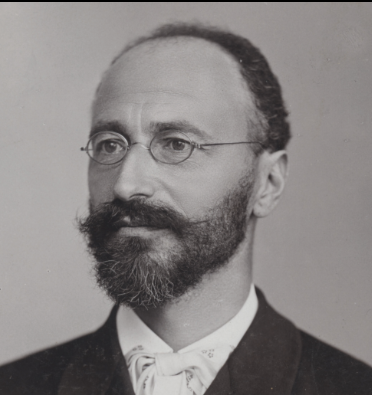
Life summary
Eugen von Böhm-Bawerk (1851–1914) was one of the great pillars of the Austrian School of Economics, together with Carl Menger (founder) and Friedrich von Wieser. He is considered the most important Austrian economist of the second generation and a key thinker in the liberal and subjectivist tradition.
Brief biography
- Born on 12 February 1851 in Brno (Brünn), then part of the Austro-Hungarian Empire (today Czech Republic).
- He studied Law in Vienna, but trained in economics under the influence of Menger’s Marginalist Revolution (1871).
- He was a professor at the universities of Innsbruck and Vienna.
- He served as Minister of Finance of Austria on several occasions (1895–1904), where he defended budget balance, the gold standard, and orthodox fiscal policies (he was a man of principle who said “no” to uncontrolled spending).
- He died on 27 August 1914, at the start of the First World War.
His main contributions (from the Austrian perspective)
Böhm-Bawerk is famous for three fundamental contributions:
-
Theory of Capital and Roundabout Production (Roundaboutness)
- He explained that capital is not only “tools,” but higher-order goods that allow longer and more productive processes of production.
- The more “roundabout” (indirect) the process (e.g., making machines to produce bread instead of hunting directly), the greater the future productivity—but it requires prior saving.
- This integrates time as a central factor in the economy.
-
Theory of Interest: Time Preference (Agio)
- Interest does not arise from exploitation (as Marx or the socialists said), but from the natural human preference for present goods over future goods.
- Individuals value the immediate more (uncertainty, present needs). Interest is the “price of time.”
- This is one of the cornerstones of the Austrian theory of the business cycle (later developed by Mises and Hayek).
-
Devastating critique of Karl Marx
- In his masterwork Capital and Interest (1884–1889, three volumes), especially in the third volume, he dismantled the theory of exploitation and the Marxist labor theory of value.
- Capitalists do not exploit workers: they pay them in advance (before the product is sold), assuming the risk and the waiting time.
- The Marxist “surplus value” completely ignores the temporal dimension and subjective preference.
- Mises and Rothbard considered this critique definitive.
Main works
- Capital and Interest (1884–1889) — his crowning work.
- The Positive Theory of Capital (1889).
- Control or Economic Law and other essays against socialism.
What critiques his ideas received
He received significant critiques of his ideas, especially of his theory of capital (roundabout productive processes or roundaboutness) and his theory of interest based on time preference (agio). As a central figure of the Austrian School, his contributions were praised within his tradition (Mises, Rothbard, and Huerta de Soto consider them fundamental), but attacked from outside and debated even internally.
1. Marxist and socialist critiques (the fiercest)
Böhm-Bawerk devoted a large part of his work to dismantling Marx’s (and Rodbertus’s) theory of exploitation. He argued that the capitalist does not exploit the worker: he pays him in advance (present wages) while assuming the risk and the temporal wait until the future product is sold.
- Rudolf Hilferding (1904) and other Marxists responded harshly, accusing him of ignoring the labor theory of value and of ideologically defending capitalism. For Marxists, his critique was “bourgeois” and did not really refute the Marxian system (though many admit that he exposed serious contradictions in the transformation of values into prices).
- Authors such as Nikolai Bukharin or Louis Boudin also attacked him. In the Marxist tradition, Böhm-Bawerk is still seen as one of the main intellectual enemies.
From the Austrian view, his refutation remains one of the most solid against Marxism.
2. Neoclassical and mainstream economics critiques
- John Bates Clark (and the American neoclassical school): He debated intensely with Böhm-Bawerk on the nature of capital. Clark saw capital as a homogeneous “fund” or perpetual “jelly of value.” Böhm-Bawerk called it “mystical” and “mythological,” insisting that capital consists of specific heterogeneous goods in temporal processes. Clark and other neoclassicals criticized his temporal and “physical” approach to the period of production.
- Alfred Marshall and others: They questioned his historical interpretation of earlier authors (such as Turgot) and his rejection of pure productivity theories of interest.
- Irving Fisher: He debated whether the productivity of roundabout processes is independent of subjective valuations. Fisher (and Stigler later) argued that Böhm-Bawerk did not properly understand simultaneous equilibrium and mathematical models.
Böhm-Bawerk rejected the static and general-equilibrium approach of the neoclassicals, preferring a causal-realist explanation.
3. Internal critiques or from within the Austrian tradition itself
Even among the Austrians there were nuances:
-
Carl Menger (his mentor) saw limitations in his theory of capital, considering it insufficiently subjectivist or too influenced by classical elements.
-
Ludwig von Mises and Murray Rothbard:
- Although they admired him deeply, they refined his ideas.
- Mises emphasized praxeology and human action more;
- Rothbard and Huerta de Soto criticize that Böhm-Bawerk sometimes used somewhat “physical” examples or averages of the period of production, which can give rise to misunderstandings (such as “reswitching” in the capital debates of the 1960s–70s).
-
Ludwig Lachmann and others: They stressed that capital is more heterogeneous and subjective than Böhm-Bawerk made explicit in some examples.
Balance
- Böhm-Bawerk was a giant who elevated the Austrian School with logical rigor and a defense of classical libertarianism (gold standard, fiscal balance, against socialism).
-
His critiques of Marx remain classics, and his integration of time and time preference is essential for understanding business cycles (the basis of the Mises–Hayek Austrian theory of the cycle).
-
His weaknesses (e.g., a certain residual objectivism in measures of capital or arithmetic examples) were corrected by later generations, who became more radically subjectivist and praxeological. As Huerta de Soto says, his work is a pillar, but not the end of the road.
He received attacks mainly for being an implacable defender of the free market and for exposing the fallacies of socialism and of neoclassical/Keynesian interventionism. His ideas have withstood the passage of time better than those of his critics.
Legacy in the liberal and Austrian tradition
Böhm-Bawerk combined deductive theoretical rigor with a practical defense of classical libertarianism:
- private property, free market, sound money, and limitation of the State.
- He influenced Mises (his student), Hayek, Rothbard, and Huerta de Soto directly.
- His emphasis on Subjectivism, time, and the structure of capital remains essential for understanding business cycles, saving, and why interventionism generates distortions.
Böhm-Bawerk was an economist, politician, and moral philosopher who elevated the Austrian School to a higher level, closing the door on objectivist fallacies (Ricardo–Marx) and opening the way to a deep praxeological understanding of human action.
This article is part of the Basic Course on Libertarianism and the Austrian School of Economics-> Module 4: Main Schools of Economics
| Previous topic | Next related topic | |
|---|---|---|
| <- Carl Menger (1840–1921) | <---> | Ludwig von Mises (1881–1973)-> |
Last updated: 2026-04-24
| | | |
This site was written based on publicly available free articles from the internet.
The content of this site is available under the: Creative Commons Attribution 4.0 International (CC BY 4.0) license.
You can freely copy, redistribute and modify the material, as long as the source is mentioned: liberwiki.com