


Ludwig von Mises
This article is part of the Basic Course on Libertarianism and the Austrian School of Economics-> Module 4: Main Schools of Economics
Last updated: 2026-05-13
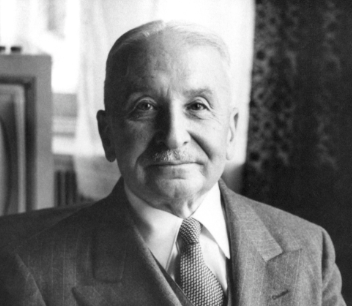
Ludwig Heinrich Edler von Mises (1881–1973), one of the most important economists of the twentieth century and a central figure of the Austrian School of Economics.
Main ideas
1. Praxeology: The Deductive Method of Human Action
Mises held that economics is not an empirical science of statistical regularities, but a science based on the fundamental idea: Man acts (that is, he employs scarce means to achieve subjective ends).
From this base the categories of action are deduced logically: means and ends, time preference, opportunity cost, etc.
Praxeology is the method that makes it possible to arrive at universal and immutable economic laws, independent of time and place.
2. The Socialist Economic Calculation Debate (1920)
This is, without a doubt, Mises’s most devastating historical and economic milestone. In his article Economic Calculation in the Socialist Commonwealth, Mises logically demonstrated why socialism and central planning are condemned to failure.
The Impossibility of Calculation:
Without private property in the means of production, there are no factor markets; without markets, real monetary prices do not emerge. Without free prices, the central planner suffers from an irremediable epistemological blindness: he is incapable of calculating costs, determining efficiency, or knowing which projects constitute malinvestment and which are viable.
Historical and Material Consequence:
As observed in historical experiments (from Lenin’s War Communism to the five-year plans), the suppression of the market destroys society’s information circuit, generating mass famines, accumulation of sterile scrap, and the degradation of the population’s adaptive resilience.
3. The Austrian Theory of the Business Cycle (ABCT)
Mises integrated monetary theory with capital theory (building on the ideas of Eugen von Böhm-Bawerk) to explain the real origin of economic crises and recessions.
- Money Is Not Neutral and the Cantillon Effect: Mises showed that the artificial creation of money and the coercive lowering of interest rates by central banking are not innocuous. They send a false signal to entrepreneurs, making them believe that there exists real saving that society never carried out.
- The False Boom and the Purge: This triggers an artificial boom based on malinvestment (unsustainable long-term investments). The subsequent crisis or recession is not a failure of the free market, but the necessary purge phase to liquidate the errors induced by state manipulation of credit and to redirect resources toward what consumers really demand.
4. The Law of Association
Mises named and elevated what was classically known as David Ricardo’s Law of Comparative Advantage into a universal law of social cooperation and human action.
- Overcoming Tribal Atavism: Mises showed that the division of labor and peaceful cooperation benefit all individuals, even when one of them is absolutely more skilled than the other at all tasks.
- Evolutionary Dimension: This law acts as the cultural and institutional software that allowed humanity to transcend the zero-sum cognitive bias inherited from the Paleolithic (where one person’s gain was the death or starvation of the rival), transforming biological diversity and inequality of capacities into a massive engine of productivity, civil peace, and demographic multiplication.
5. The Critique of Interventionism and “German-Pattern Socialism”
In works such as Interventionism and Omnipotent Government, Mises analyzed how any coercive intrusion of the State into the market (price controls, tariffs, asymmetric regulations) generates systemic distortions.
- The Slippery Slope: Since each intervention generates new disequilibria (for example, price controls generate scarcity), the State is pushed to intervene in the adjacent sector or to advance toward total control.
- Fascism and Collectivism: Mises brilliantly argued that regimes such as Italian fascism or German National Socialism were not forms of “capitalism,” but variants of collectivism and of vertical state control of the means of production (what he called German-pattern socialism), in which the nominal facade of private property was maintained but consumer sovereignty was completely suppressed.
Synthesis for the Conceptual Framework
To close the conclusions, the work of Ludwig von Mises converges on a central thesis: individual liberty and the market economy are not mere ideological preferences or accounting whims, but the indispensable biological and epistemological condition for the homeostasis of advanced civilization. Every attempt to replace spontaneous order with central planning or coercive interventionism represents a regressive atavism that blinds society and leads it inexorably to collapse.
Life
Childhood and formation (1881–1913)
- Born on 29 September 1881 in Lemberg (today Lviv, Ukraine), then part of the Austro-Hungarian Empire, into a Jewish family of the enlightened bourgeoisie.
- He studied Law and Economics at the University of Vienna. His great formative influence was Eugen von Böhm-Bawerk, though he also read Carl Menger (founder of the Austrian School) deeply.
- In 1906 he obtained his doctorate in Law. He worked as an economist at the Vienna Chamber of Commerce, where he remained until 1934, combining professional practice with theoretical research.
Viennese period and the Great War (1913–1934)
- In 1912 he published his first major work: The Theory of Money and Credit, in which he integrates monetary theory with capital theory and economic cycles. There he develops the Austrian theory of the business cycle (artificial credit expansion generates boom and subsequent depression).
- He served in the Austro-Hungarian army during the First World War (artillery).
- In 1920–1922 he wrote his famous article “Economic Calculation in the Socialist Commonwealth,” in which he demonstrates that socialism is impossible from an economic point of view because of the absence of market prices and rational calculation. This work opened the great debate on socialist calculation.
- In 1926 he founded the Privatseminar Mises, a weekly discussion circle in Vienna attended by figures such as Friedrich Hayek, Fritz Machlup, Oskar Morgenstern, Gottfried Haberler, and others.
- In 1928 he published a preliminary version of Human Action.
Exile and maturity (1934–1973)
- Faced with the rise of Nazism, in 1934 he moved to Geneva (Switzerland), where he was a professor at the Graduate Institute of International Studies. There he met his future wife, Margit Sereny (they married in 1938).
- In 1940, with the Nazi invasion of France and the imminent risk, he emigrated to the United States (he arrived in New York in August 1940). The first years in America were economically difficult; he lived on scholarships and help from friends.
- In 1949 he published his magnum opus: Human Action, a monumental work of more than 900 pages that reformulates all of economics as a praxeological science (science of human action) that is deductive and a priori, opposed to positivism and historicism.
- He taught at New York University (1945–1969) as a visiting professor, never obtaining a full chair at a major American university (which reflects the rejection of the Keynesian establishment of the time).
- He founded the Mont Pelerin Society together with Hayek, Friedman, and others in 1947, though he later distanced himself from some directions the society took.
- He continued writing to the end: Theory and History (1957), The Anti-Capitalistic Mentality (1956), Socialism (revised edition), etc.
Death and legacy
He died on 10 October 1973 in New York, at age 92. His ashes were scattered at the cemetery in Montreux, Switzerland.
Main legacy (from the Austrian perspective):
- He radically defended classical libertarianism and free-market capitalism without interventionism.
- He developed praxeology as the method of the social sciences.
- Devastating critique of socialism, interventionism, and Keynesianism.
- Direct influence on Friedrich Hayek (Nobel Prize 1974), Murray Rothbard, Israel Kirzner, Jesús Huerta de Soto, and the entire modern Austrian renewal.
Mises was a thinker coherent to the extreme: he never yielded to intellectual fashions. As Hayek said: “Mises was a man of extraordinary intellectual courage.”
What are his most curious or contradictory ideas?
Ludwig von Mises is one of the most coherent thinkers of the twentieth century, but precisely because of his logical radicalism there arise ideas that seem curious, paradoxical, or even shocking to the modern reader (even within the liberal tradition).
1. The comment on fascism (the most polemical and taken out of context)
In Libertarianism (1927), Mises writes that Italian fascism “has earned for itself an eternal place in history” for having saved Europe from the immediate Bolshevik threat.
Contradiction? Immediately afterward he harshly criticizes fascism: it is violent, statist, nationalist, and anti-liberal. He sees it as a temporary lesser evil, not as a model.
This generates constant accusations of “crypto-fascist,” but in reality it reflects the context of 1920–1926: the Red Terror in Italy and Hungary. Mises always defended classical libertarianism as the definitive antidote against every form of collectivism.
2. Extreme praxeological apriorism
Mises holds that economics is a deductive and a priori science (like logic or mathematics): we start from the axiom “man acts” and derive everything without need of empirical testing of the fundamental theorems.
Curiosity/paradox: He rejects the empirical-positivist method (Keynes, Friedman) as inadequate for the social sciences, but his conclusions (impossibility of socialism, theory of the cycle) have been fulfilled repeatedly in history. Critics call him “dogmatic”; Austrians reply that he is as “dogmatic” as Euclidean geometry.
3. Interventionism as a “logically impossible” and self-destructive system
Mises holds that interventionism (the “third system” between capitalism and socialism) is not viable: each intervention generates problems that require more interventions, until one arrives at socialism or returns to the free market.
Curiosity: He rejects any “mixed economy” as stable. It is one of his hardest theses and one that most irritates Keynesians and social democrats.
4. Radical anti-egalitarianism and “intellectual elitism”
Mises rejects “equality of outcomes” and the sentimental idea of moral equality among all men as to capacities. He writes things such as that the masses must recognize that they owe their improvements to “superior” men (entrepreneurs, inventors).
Paradoxical for a liberal: He defends liberty for everyone, but without egalitarian romanticism. He influenced Ayn Rand on this point (they corresponded).
5. Other lesser curiosities
- Almost total rejection of mathematics in economics (he calls them a “game” or “pseudo-science”) despite his extreme logical rigor.
- Regression theorem of money: Money must arise from the market (commodity money); it cannot be created by decree. This generates endless debates with bitcoin and fiduciary currencies.
- Liberal utilitarianism: He justifies liberty not by absolute natural rights (as Locke or Rothbard), but because it produces the greatest possible prosperity (though he later derives almost absolute principles).
Balance from the Austrian view
These “contradictions” are usually apparent: Mises is coherent within his deductive system. What bothers people is his intransigence: he offers no “third ways,” makes no concessions to intellectual fashion, and states politically incorrect truths without softening them. As he himself said: “Truth is not democratic.”
What were the main critiques of his ideas?
Mises’s ideas, being so radical and distant from the academic “mainstream” of his time, faced fierce critiques from multiple fronts: Marxism, Keynesianism, and even from other liberal sectors.
Here is a summary of the main critiques divided by area:
1. Critique of Method: The Rejection of Praxeology
This is the most common academic critique. Mises held that economics is an a priori science (pure logic) and that it needs neither experiments nor data to validate its laws.
- The argument against: Positivist and empirical economists (such as those of the Chicago School or the Keynesians) argue that if a theory cannot be tested or “falsified” with real-world data, it is not science, but dogma or religion.
- The critique: He was accused of being “anti-scientific” for rejecting the use of mathematics and statistics to measure human behavior.
2. The Economic Calculation Debate
Although his critique of socialism was devastating, he received important technical responses from economists such as Oskar Lange.
- The argument against: Lange proposed “market socialism,” suggesting that a central planning board could simulate the market through a system of “trial and error” with prices, adjusting them according to whether products were in surplus or shortage.
- The critique: Critics held that Mises underestimated the capacity of technology (and today would say of Artificial Intelligence) to process information and allocate resources without need of private property.
3. Political and Social “Extremism”
Many liberal thinkers considered that Mises’s stance was so inflexible that it became impracticable in modern society.
- The argument against: Milton Friedman and other monetarists criticized his insistence on the absolute gold standard and his rejection of any role for the State in managing currency. They considered that his proposals could lead to dangerous economic rigidity in times of crisis.
- The critique: He was labeled “reactionary” or utopian for not accepting that certain market failures (such as externalities or public goods) might require minimal state intervention.
4. The Critique of F.A. Hayek (His Own Disciple)
Although they shared the base of the Austrian School, Hayek diverged from Mises’s method on key points.
- The argument against: While Mises relied on pure reason and logic, Hayek focused on spontaneous evolution and dispersed knowledge. Hayek believed that human reason is limited and that institutions (such as language or the market) arise by historical accident, not by logical design.
- The critique: For Hayek’s followers, Mises’s approach was too “rationalist,” almost as if it pretended that the economist can know everything through logic, falling paradoxically into a form of intellectual arrogance.
Summary of critiques by school:
| School / Author | Main Critique |
|---|---|
| Keynesians | The market does not regulate itself; lack of state intervention generates chronic unemployment. |
| Positivists / Chicago | Economics must be based on data and mathematical models, not only on deductive logic. |
| Socialists (Lange) | It is possible to simulate economic calculation with computers and central planning. |
| Hayek (Evolutionism) | Society is too complex to be explained only through logical axioms. |
Despite these critiques, time vindicated him on points that seemed impossible in his moment, such as the long-run economic inviability of the Soviet regimes.
This article is part of the Basic Course on Libertarianism and the Austrian School of Economics-> Module 4: Main Schools of Economics
| Previous topic | Next related topic | |
|---|---|---|
| <- Eugen von Böhm-Bawerk (1851–1914) | <---> | Friedrich Hayek (1899–1992)-> |
Last updated: 2026-05-13
| | | |
This site was written based on publicly available free articles from the internet.
The content of this site is available under the: Creative Commons Attribution 4.0 International (CC BY 4.0) license.
You can freely copy, redistribute and modify the material, as long as the source is mentioned: liberwiki.com