


Murray Rothbard
This article is part of the Basic Course on Libertarianism and the Austrian School of Economics-> Module 4: Main Schools of Economics
Last updated: 2026-05-16
Life and work
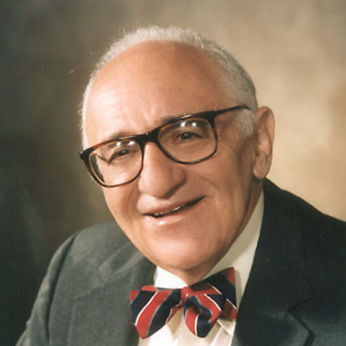
Murray Newton Rothbard (1926–1995) was an American economist, historian, and political theorist, unanimously recognized as the founding father of anarcho-capitalism and the principal architect of the modern libertarian movement.
1. Life and Intellectual Trajectory
Murray Rothbard was born in the Bronx, New York, into a family of Jewish immigrants. Possessing a brilliant intelligence and an insatiable curiosity, he studied mathematics and economics at Columbia University, where he earned his Ph.D. in Economics.
Despite being educated in an environment strongly influenced by the Keynesian and left-wing currents of the time, Rothbard always felt drawn to the ideas of liberty. His definitive turning point came in 1949 with the publication of Human Action, the crowning work of Ludwig von Mises. Rothbard was dazzled by the logical coherence of the Austrian School and began attending Mises’s celebrated seminar at New York University regularly.
From then on, Rothbard carried the premises of Mises and of classical libertarianism to their most radical conclusion: if the free market is efficient at providing food, footwear, and education, it must also be efficient at providing the services traditionally monopolized by the State, such as security, police, and justice. Thus was born his total conversion to private-property anarchism. During his mature years he taught at the Brooklyn Polytechnic Institute and, later, at the University of Nevada, Las Vegas (UNLV).
2. Work and Fundamental Contributions
Rothbard was an astonishingly prolific writer. He published more than twenty books and thousands of academic and journalistic articles in which he unified Austrian economics, history, and moral philosophy under a single coherent system.
Key Books
- Man, Economy, and State (1962): A monumental treatise on economics that expands and systematizes Misesian praxeology, presenting economic theory in a deductive and accessible manner.
- America’s Great Depression (1963): In this work of economic history, Rothbard applies the Austrian Theory of the Business Cycle to demonstrate that the stock market crash of 1929 was not a failure of capitalism, but the direct result of the artificial credit expansion brought about by the Federal Reserve.
- For a New Liberty: The Libertarian Manifesto (1973): A brilliant and more popular exposition in which he explains how an entirely free society would work, covering the privatization of roads, schools, courts, and private protection services.
- The Ethics of Liberty (1982): His most important philosophical work. In it he details the legal and moral structure of an anarcho-capitalist society, deriving all rights from private property and original appropriation (the mixing of labor with land).
- An Austrian Perspective on the History of Economic Thought (two volumes published posthumously): A critical revision of economic history, recovering the contributions of the School of Salamanca and demolishing myths surrounding figures such as Adam Smith or Karl Marx.
Main ideas
Murray Rothbard’s main ideas constitute a fully unified philosophical, ethical, and economic system. Unlike other liberal thinkers who defended liberty on grounds of economic efficiency (utilitarianism), Rothbard built an absolutist defense based on deductive moral principles.
1. The Axiom of Self-Ownership
It is the cornerstone of his entire political and moral philosophy. Rothbard held that every individual is the legitimate and absolute owner of his own body and mind. From this axiom it follows that no entity (neither a king, nor a democratic majority, nor the State) has a superior right over a person’s life or destiny than the person himself.
2. The Non-Aggression Principle (NAP)
Derived directly from self-ownership, the NAP is the central ethical rule of libertarian society. It establishes that no individual or group of individuals has the right to initiate physical violence, or the threat of it, against the person or the legitimate property of another.
- Rothbard drew a crucial distinction: violence is wrong only when it is initiated (aggression), but it is perfectly legitimate when used in response to prior aggression (self-defense).
3. The Theory of Property and Original Appropriation (Homesteading)
For Rothbard, individual liberty is inseparable from private property. Following the tradition of John Locke, he explained that property rights over natural resources and material goods are acquired legitimately in three ways:
- Original appropriation: When a person takes a resource that belongs to no one (virgin land, for example) and “mixes his labor” with it, transforming it and making it useful.
- Voluntary exchange: Trading legitimately acquired goods through free contracts.
- Gift: Receiving a good voluntarily from its previous owner.
Any other way of acquiring property (such as theft or expropriation) is immoral because it violates the NAP.
4. Anarcho-Capitalism (The Abolition of the State)
This is Rothbard’s most famous and radical contribution, of which he is considered the founding father. Applying relentless logic, he pointed out that if self-ownership and the NAP are valid for ordinary citizens, they must also apply to those who govern.
Under this premise, Rothbard concluded that the State is an intrinsically criminal and illegitimate organization for two reasons:
-
Taxation is theft: The State finances its activities through compulsory collection under threat of prison or violence, which breaks the Non-Aggression Principle.
-
It is a coercive monopoly: The State forcibly prohibits other agencies from competing with it in the provision of essential services.
Rothbard proposed replacing the State with a fully free market, in which even the services of justice, courts, police, and security would be provided by private firms in free competition and financed through entirely voluntary contracts.
5. The Denationalization of Money and the Gold Standard
In the economic sphere, Rothbard applied the monetary theory of the Austrian School to demonstrate that money should not be controlled by governments.
- He held that central banks are monopolies created to counterfeit money legally (inflation), which erodes people’s purchasing power and benefits financial elites (the so-called Cantillon Effect).
-
He argued that state manipulation of interest rates distorts market signals, causing malinvestment and giving rise to economic cycles of artificial boom followed by deep recessions.
-
His proposal was to abolish central banks and return to a system of market money, firmly defending the gold standard or free competition among privately issued currencies.
6. A Revision of Economic and Political History
Rothbard did not only theorize about what ought to be; he applied his analytical framework to real history. In his works he showed that the great economic failures historically attributed to free-market capitalism (such as the crisis of 1929) were, in reality, the consequence of government interventions and of bad central-bank policies.
Rothbard’s great idea was to demystify the figure of the State, stripping it of its aura of the “common good” and demonstrating that a society can organize itself in a peaceful, just, and prosperous way based exclusively on private property rights and strictly voluntary agreements.
Main critiques of his ideas
Murray Rothbard’s thought, characterized by carrying the premises of liberty and the market to their ultimate logical consequences, generated heated debates both inside and outside the libertarian movement. Below are the main critiques his ideas received and the responses he articulated in their defense:
The foundation of liberty: Rationalism vs. utilitarian evolutionism
- The critique: Intellectuals from within the Austrian School and classical libertarianism itself, notably Friedrich Hayek, criticized Rothbard’s rationalist and dogmatic natural-rights doctrine. For Hayek, liberty is not derived from abstract a priori axioms given by nature; it is valuable because it is useful to society and allows the development of a spontaneous order based on dispersed knowledge. Critics pointed out that Rothbard’s pure deductive method preferred logical rigidity over the analysis of historical institutions and of real human adaptation.
- Rothbard’s response: Rothbard rejected the idea of grounding liberty in mere practical utility or in the convenience of results, labeling it a “weak” defense. For him, if respect for individual rights depends on whether it yields an economically efficient result, the door is left open for the State to intervene by invoking a supposed “common good” or a superior collective utility. Rothbard prioritized unbreakable logical deduction over the comfort of academic consensus.
The disagreement with Socialist Anarchism
- The critique: Traditional currents of left-wing anarchism (communists, collectivists, and mutualists) entirely rejected the term “anarcho-capitalism.” They held that capitalism is intrinsically hierarchical and that private ownership of the means of production recreates structures of domination and oppression similar to those of the State.
- Rothbard’s response: Rothbard explained that there is a fundamental difference between the genuine free market and “state capitalism” or corporatism (where firms use government power to obtain coercive privileges). He defended private property as perfectly legitimate when it comes from original appropriation through labor (homesteading). He argued that while the free market consists exclusively of peaceful and voluntary exchanges, socialist systems necessarily require a centralized and violent apparatus to prohibit property and prevent individuals from trading freely, thereby falling into collectivist statism.
The viability of private justice and security (Minarchist critique)
- The critique: Limited-government thinkers (minarchists such as Robert Nozick) pointed out that the total absence of a State would lead to chaos or civil war among competing private security agencies, since there would be no court of last resort with a legitimate monopoly to resolve final rulings or disputes.
- Rothbard’s response: Rothbard argued that private protection agencies would have an enormous economic incentive not to resort to armed violence, given that war destroys capital and is extremely costly for business. Just as countries or multinational corporations resolve complex legal disputes without need of a single world government, security agencies would resolve their disagreements by voluntarily submitting to independent private arbitration and adopting common legal codes based strictly on respect for private property and the NAP.
The protection of children and acts of omission
Before beginning this section, the following is explained:
-
Being a libertarian does not mean accepting every idea, but using one’s own judgment to decide; we are not a herd; each person is responsible for his ideas and decisions.
-
As the reader (you) has surely been discovering, within libertarian ideology there are more radical and extreme thinkers and others who are less so. If you are not up to date on this subject you should go back and read: Definition of Libertarianism. Rothbard represents the most extreme libertarian ideas.
-
The writer (I) believes that on this entire point in question Rothbard is wrong on one principal point: That children are the fruit of their parents’ action, and therefore there exists a minimum ethical and biological responsibility to raise one’s own children. Not raising one’s own children goes against human nature itself, from a biological and ethical point of view, especially taking into account the philosophical current that is the base of libertarianism, namely Natural Law.
-
Continuing with the subject, one should ask how the process of adopting children currently works in each country, and above all what legal tools a child who is abused or mistreated in his own family has to escape such a hell, when it is evident that the parents have no interest in caring for their children.
- Are children really cared for by the State? Does the State really guarantee the care of children abandoned by their parents?
- Does the State carry out follow-up for children who were placed for adoption? Are there cross-checks for this verification?
- In cases of abuse or violence, do the laws allow the child to escape hell easily?
- Rothbard proposes a possible libertarian solution to these questions.
With that said, and taking into account the points named above, the analysis continues.
This video is very useful for contextualizing the controversy around the “adoption market” proposed by Rothbard, explaining from a philosophical and political perspective the limits and logical rigor of his arguments about children’s rights.
The “child market” in adoption
To understand one of Murray Rothbard’s most controversial proposals — what his detractors pejoratively called a “baby market” — it is necessary to separate it from everyday prejudices and analyze it under the rigorous deductive framework he sets out in his political philosophy. Rothbard did not defend cruelty or abandonment; on the contrary, he considered that his conclusions were the only coherent way to structure a completely free society without granting coercive power to the State.
1. The Philosophical Foundations (The “Why” of his ideas)
All of Rothbard’s theory is built in a chain from a single absolute axiom: the Non-Aggression Principle (NAP). From this principle is deduced a fundamental legal distinction for understanding his position:
- Acts of Commission vs. Acts of Omission: The NAP determines that law and justice should only punish acts of commission, that is, the initiation of real and direct physical violence against another person’s body or property.
- The rejection of forced labor: By contrast, the law cannot compel an individual to perform a positive act or to provide a good or service by force (which would constitute action against an omission). For Rothbard, legally forcing a person to work or to hand over specific resources for the benefit of a third party is equivalent to a form of forced labor.
2. The Status of Children and Omission
When applying this rigorous logical framework to the family relationship, Rothbard reaches conclusions that clash with traditional social consensus:
- The non-enforceability of care under the law: According to this deduction, a parent has a moral obligation to support his child, but not a legally enforceable obligation under libertarian law. If a parent decides to stop feeding or caring for his child, this constitutes an act of omission (passive neglect), not an act of commission (real physical violence). For Rothbard, legally forcing a parent to work or to provide a specific resource for the minor is equivalent to a form of forced labor.
3. The Practical Solution: The Market in Custody Rights
Knowing that the law cannot force parents to raise their children, Rothbard argues that the humanitarian and efficient way to resolve this situation in a free society is to allow a free market in adoptions.
- Voluntary exchange of custody rights: Since biological parents hold guardianship but cannot be forced to exercise it, they are free to renounce it or transfer it. In a free market, this transfer of custody rights would take place in a fully voluntary manner between the parties.
- Sale of guardianships, not of human beings: It is vital to clarify that in this scheme the child is not sold as if he were an object or a slave; what is traded is the legal right of custody and care of the minor. The child, possessing potential self-ownership, cannot be the absolute property of anyone.
4. Why did he consider it a beneficial proposal?
Rothbard argued that a free market in adoptions would bring practical advantages far superior to those of the state system:
- Allocation to families with resources and genuine desire: Rothbard held that families willing to pay for a custody right guarantee that they truly want the child and that they have the economic means necessary to raise and feed him adequately.
- Elimination of orphanage bureaucracy: This would make it possible to replace the inefficient and slow state bureaucratic orphanage system with an agile and humanitarian mechanism guided by voluntary agreements. The minor would quickly leave a situation of disinterest or passive abandonment to join an optimal home.
- Incentive against abortion or destitution: For biological parents without resources or facing unwanted pregnancies, the possibility of receiving economic compensation in exchange for ceding custody would give them a viable economic alternative, reducing abandonments under dangerous conditions.
5. Why did Rothbard defend this? (The deeper reason)
It was absolute coherence with his system. He made no exceptions “for humanity” or “for parental instinct”:
- Praxeology + natural law: If self-ownership is universal and rights are negative (laws only prohibit, they do not compel), any exception (such as “parents must feed their children by law”) introduces state coercion and violates the NAP. Creating a positive obligation is as illegitimate as slavery.
- Critique of the State: Today the State decides what a “good parent” is (custody laws, abortion, compulsory education). Rothbard wanted to eliminate that monopoly: the family should be governed by private contracts and customary law (polycentric law), not by bureaucrats.
- Biological and evolutionary vision: Human nature is action and scarcity. The parental bond is an evolutionary trait (natural selection favors care of offspring), but it is not an enforceable positive right. Forcing care via the State distorts the spontaneous order of the family, just as it distorts the market. Voluntary charity and the custody market would be more efficient and ethical.
- Rejection of utilitarianism: Although it “sounds cruel,” Rothbard said that emotional consequences do not invalidate ethics. Logical truth takes priority over sentimental intuitions.
In summary: he did not defend “exploiting children” or “selling them as slaves.” He defended that the family is a private matter, and that any state intervention (even “to protect the child”) is illegitimate aggression. The “child market” is simply the logical corollary of a world of 100% private law.
4. Why it caused so much scandal (and remains controversial)
- Even minarchist libertarians (Nozick, Friedman) and some Austrians rejected it: it seemed to allow extreme neglect or “legal abandonment.”
- Left-wing critics accused him of justifying pedophilia or exploitation (a gross distortion).
- Rothbard always replied the same way: “If you don’t like it, donate money to rescue children or adopt yourself. But don’t use the State to impose your morality.”
This position is the perfect example of his radicalism: he preferred a world in which some children suffered from voluntary parental abandonment to a world in which the State had power to define the “correct family.”
Rothbard’s Legacy
Rothbard’s impact remains fully current and is articulated along three major axes:
-
Co-founding of the Mises Institute: In 1982, together with Llewellyn Rockwell and Burton Blumert, he founded the Ludwig von Mises Institute in Alabama. This institution became the beacon of the Austrian School worldwide, digitizing and offering radical economic and philosophical knowledge free of charge to millions of people.
-
Demystification of the State: Rothbard transformed libertarianism from a marginal current into an integral and radical system. He demonstrated that the State is not a necessary evil, but “the organization of systematic theft,” and that the free market (with 100% reserve banking, the gold standard, and private law) generates a superior spontaneous order. His emphasis on a priori praxeology, Subjectivism, and methodological individualism distinguishes him from the empirical approaches of Chicago or the mainstream.
-
Key influence:
- He theoretically founded anarcho-capitalism, influencing figures such as Hans-Hermann Hoppe.
- His historical revisionism (on wars, depressions, and the New Deal) challenges official narratives.
- In economics: defense of entrepreneurship as coordinator, critique of fractional-reserve banking as fraud, and the business cycle as a monetary phenomenon.
His legacy is controversial: admired for his radical coherence and criticized by minarchist purists or for his combative style. However, in a world of expansive States and fiat money, his ideas gain relevance as a precise diagnosis of interventionism and as a vision of a private-law society.
Rothbard is Mises at his purest and most applied: not only an economist, but a passionate defender of civilizing liberty against state barbarism. His works remain essential for understanding why laissez-faire capitalism is not a utopia, but the only system compatible with human nature.
This article is part of the Basic Course on Libertarianism and the Austrian School of Economics-> Module 4: Main Schools of Economics
| Previous topic | Next related topic | |
|---|---|---|
| <- Friedrich Hayek (1899-1992) | <---> | Robert Nozick (1938-2002)-> |
Last updated: 2026-05-16
| | | |
This site was written based on publicly available free articles from the internet.
The content of this site is available under the: Creative Commons Attribution 4.0 International (CC BY 4.0) license.
You can freely copy, redistribute and modify the material, as long as the source is mentioned: liberwiki.com