


Theory of Capital
This article is part of the Intermediate course on Libertarianism and the Austrian School of Economics -> Pending Concepts of Austrian Economics
Last updated: 2026-08-21
Definition
The theory of capital by Eugen von Böhm-Bawerk is one of the pillars of the Austrian School of Economics. It is primarily found in his three-volume work Capital and Interest (1884–1889) and in The Positive Theory of Capital.
Böhm-Bawerk does not treat capital as a “homogeneous fund” or as a mere monetary magnitude, but as a temporal structure of intermediate goods.
For Austrians, capital is not a bank balance. It is structure: specific goods combined by someone who postpones consumption, bears uncertainty, and corrects errors.
Indirect Methods of Production (Roundaboutness)
The core of Böhm-Bawerk's theory holds that "the productivity of human labor increases exponentially if production becomes" more indirect, long-term, or more time-consuming/roundabout (roundaboutness):
Direct method (Short-term):
A castaway can quench his thirst by drinking water directly from a river with his hands (immediate effort, low productivity).
Indirect method (Long-term / Capitalized):
The castaway decides to spend several days (consuming his savings of previously gathered food) making a bucket and digging a well.
During that time he produces no water directly, but once the system (the capital good) is finished, his productivity multiplies massively.
Böhm-Bawerk demonstrated that the longer and more capitalized the production process is, the greater the final abundance of consumer goods that society can enjoy.
Human Action and Time Preference
Because human beings are mortal and possess scarce resources, we value present goods more than equivalent future goods: this is time preference.
The sacrifice of the present: To accumulate capital, an individual must exercise rational agency by deciding to postpone immediate consumption.
Real savings is not sterile hoarding, but the voluntary release of physical resources (food, energy, raw materials) to allow workers and entrepreneurs to dedicate themselves to building tools and capital goods that will bear fruit later on.
Intertemporal Structure of Production
The intertemporal structure of production is, in essence, the elaboration and graphical representation that Hayek (and later Austrians) made of Böhm-Bawerk's theory of capital.
Eugen von Böhm-Bawerk, in his Positive Theory of Capital (1889), established the foundations:
- Production is a time-consuming process. “Indirect” or roundabout methods are used (more stages, more waiting) because they are more productive: they allow better exploitation of natural forces, the use of more tools, and the attainment of more or better consumer goods.
- Capital goods are intermediate goods located at different stages or “orders” (following Menger). Some are further from final consumption and others closer.
- He introduced the average period of production as a measure of the degree of “capitalism” or roundaboutness of the process: how much time, on average, the original factors (labor and land) remain invested until becoming consumer goods.
- He represented the stages with concentric circles: the outermost ones mature sooner (closer to consumption), while the inner ones take longer.
- Prior savings (the “subsistence fund”) are what allow society to wait out those longer processes. The interest rate reflects both time preference and the productivity of those more indirect methods.
The Hayekian Triangle
Friedrich Hayek took these exact ideas and turned them into the intertemporal structure of production. In Prices and Production (1931), he visualized them with the Hayekian triangle:
- The horizontal axis represents time or successive stages.
- The vertical axis represents the value of production at each stage.
- The shape shows how value is added as goods advance toward consumption.
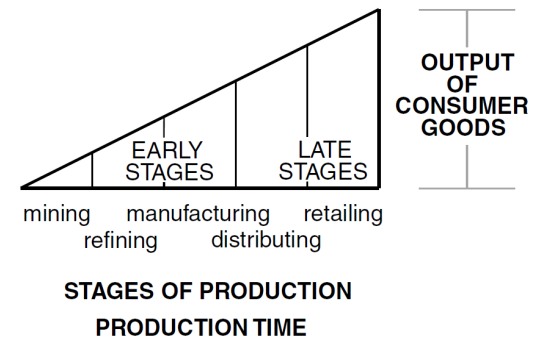
It is the same conception as Böhm-Bawerk's (production in temporal stages, more roundaboutness = higher productivity, coordination via interest rates), but presented in a more disaggregated and useful form for macroeconomic analysis—especially for explaining how a change in interest rates (or an artificial credit expansion) alters the allocation of resources between early and late stages.
Hayek explicitly acknowledged his debt to Böhm-Bawerk, although he later criticized the “average period” as an overly aggregated and problematic measure (due to difficulties with compound interest, fixed capital, and heterogeneity). He preferred to speak of the complete structural configuration of stages rather than a single average number.
In summary: Böhm-Bawerk provided the theory of capital as a temporal, stage-by-stage process; Hayek converted it into the analytical instrument of the “intertemporal structure” that Austrians use today to explain both sustainable growth (lengthening financed by real savings) and business cycles (unsustainable lengthening driven by easy credit).
The Refutation of Marxist Exploitation
Politically, this theory served to dismantle the Labor Theory of Value and Karl Marx's theory of surplus value:
Marxists argued that the capitalist "stole" part of the value by paying present wages that were less than the value of the final product.
Böhm-Bawerk explained that the wage received by the worker immediately and securely is a present good, whereas the final product finished in the future is an uncertain future good.
The capitalist performs a fundamental function: advancing secure present goods (wages) in exchange for assuming the risk of the future.
The difference in value (interest or profit) is not exploitation, but the price of time (time preference) and the reward for accumulated savings.
This article is part of the Intermediate course on Libertarianism and the Austrian School of Economics -> Pending Concepts of Austrian Economics
| Previous Topic | Next Related Topic | |
|---|---|---|
| <- Law of Association | <---> | Time Preference-> |
Last updated: 2026-08-21
| | | |
This site was written based on publicly available free articles from the internet.
The content of this site is available under the: Creative Commons Attribution 4.0 International (CC BY 4.0) license.
You can freely copy, redistribute and modify the material, as long as the source is mentioned: liberwiki.com