


Adam Smith
This article is part of the Basic Course on Libertarianism and the Austrian School of Economics-> Module 4: Main Schools of Economics
Last updated: 2026-04-10
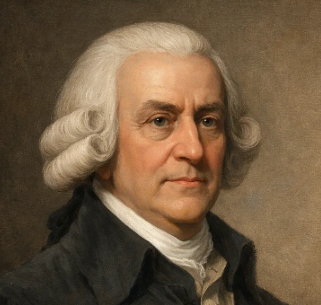
Adam Smith (baptized 5 June 1723 in Kirkcaldy, Scotland – died 17 July 1790 in Edinburgh) was a Scottish moral philosopher and political economist, a central figure of the Scottish Enlightenment.
He is considered the father of modern economics and one of the founders of classical liberal thought in economics. Although today he is associated mainly with economics, Smith was above all a philosopher who integrated ethics, human psychology, history, and institutional analysis.
His life unfolded in relative comfort (his father had been a customs official). He studied at the University of Glasgow (where he later became professor of moral philosophy) and at Oxford. He was a close friend of David Hume and belonged to an extraordinary intellectual circle. He published two main works in his lifetime:
- The Theory of Moral Sentiments (1759)
- An Inquiry into the Nature and Causes of the Wealth of Nations (1776), commonly known as The Wealth of Nations.
He died unmarried and devoted his last years to revising his texts and to his work as a customs commissioner.
Main ideas
Smith did not sharply separate ethics and economics: both arose from observation of human nature. His ideas complement each other across his two great books.
1. In The Theory of Moral Sentiments (ethics and human psychology)
- Morality is born neither of an “innate moral sense” nor of pure selfishness, but of sympathy (or empathy): the imaginative capacity to put ourselves in another’s place and share (or judge) their emotions.
- He introduced the concept of the impartial spectator: an internal judge that allows us to evaluate ourselves as if we saw ourselves from outside, seeking moral approval and avoiding excess of passions.
- The key virtues are: justice (the most important, since it protects society), prudence (care of oneself), and benevolence.
- He criticizes both pure selfishness and utopian altruism: human beings are selfish to a degree, but also sociable and desirous of mutual approval. This avoids a reductionist view of man as a mere utility maximizer.
This work is fundamental to understanding that Smith was not an apologist for crude selfishness; on the contrary, he saw morality as a social mechanism that moderates self-interest.
2. In The Wealth of Nations (political economy)
This is his magnum opus and the foundational text of economics as a systematic discipline. His central ideas are:
-
The real wealth of nations:
- is not precious metals (as the mercantilists believed), but a country’s productive capacity: the goods and services that satisfy human needs.
- Economic growth comes from increased productivity, not from accumulating gold or from favorable trade balances.
-
Division of labor:
- It is the main engine of economic progress.
- In his famous pin-factory example, he shows how specializing in simple tasks multiplies productivity enormously (a single worker makes few pins; with division of labor, thousands).
- Division of labor generates specialization, skill, innovation, and economies of scale.
- However, Smith warned that excessive repetitive work could “stupefy” the minds of workers, which is why he defended basic public education.
-
Self-interest and the “invisible hand”:
- It is not from the benevolence of the butcher, the brewer, or the baker that we expect our dinner, but from their regard to their own interest.
- Each individual, by pursuing his personal gain (and guided by prices, competition, and market signals), is “led by an invisible hand” to promote the interest of society, often without intending it.
- This is a spontaneous order: social coordination emerges without central planning.
-
Free market and critique of mercantilism:
- He defended international free trade, open competition, and the reduction of regulations, monopolies, and state privileges.
- Mercantilism (protectionism, import restrictions) impoverishes nations by distorting the allocation of resources.
-
Capital accumulation and the extent of the market:
- Division of labor is limited by “the extent of the market.” The larger the market (free trade), the more specialization and prosperity.
-
Limited role of the State:
- Only three legitimate functions for the sovereign: national defense, administration of justice (including protection of property), and public works that the private market would not provide efficiently (roads, bridges, basic education).
- Beyond that, intervention is usually counterproductive.
What or whom inspired his ideas?
He drew on a combination of personal, philosophical, scientific, and economic influences of his time and of the classical tradition.
1. Personal and environmental influences (Scottish Enlightenment)
Smith was a central product of the Scottish Enlightenment, an intellectual movement that emphasized reason, empirical observation, and the study of human nature.
-
Francis Hutcheson (his professor at the University of Glasgow): He is the most direct influence and the man Smith called “the never-to-be-forgotten Dr. Hutcheson.” Hutcheson developed the theory of the “moral sense,” which held that moral judgments arise from sentiments rather than pure reason. This deeply marked The Theory of Moral Sentiments, where Smith explores sympathy (the capacity to put oneself in another’s place) as the basis of morality. Hutcheson also influenced ideas about the common good and property.
-
David Hume (his great friend and intellectual mentor): Hume was one of the most important figures for Smith. They shared a skeptical view based on human psychology. Smith adopted and refined Hume’s ideas on sentimentalist morality, passion as the motor of action, and religious skepticism. Smith described Hume after his death as someone who approached the ideal of a “perfectly wise and virtuous man.” Almost everything in Smith’s works has some connection to or revision of Hume, though Smith did not always fully agree.
Other contemporaries such as Lord Kames (Henry Home) also supported him in his early lectures.
2. Philosophical and scientific influences
-
Stoic philosophy: Smith admired Epictetus and Marcus Aurelius. The Stoic idea of a harmonious natural order in the universe influenced his concept of the “invisible hand,” where individuals pursuing their own interest contribute (without intention) to the social good. Also in the idea of resignation before greater forces and personal virtue.
-
Isaac Newton and the scientific method: The Scottish Enlightenment was steeped in Newtonian principles (systems, mechanisms, and natural laws). Smith sought to explain society as an ordered system, similar to how Newton explained the physical universe.
-
Ancient classics: Aristotle (on virtue, imagination, and morals), Plato, and others. Smith saw parallels between his moral system and Aristotle’s.
-
Post-Calvinist thought: In Scotland, a moderate version of Protestantism influenced his work ethic and civic virtue.
3. Influences in economics and political thought
For The Wealth of Nations, Smith synthesized and surpassed earlier ideas:
-
French Physiocrats
- (François Quesnay and his school): During his travels through Europe (as tutor to the Duke of Buccleuch), Smith met the Physiocrats, who emphasized agriculture as the source of wealth, the “natural order,” and laissez-faire (let do).
- Smith praised them as the system closest to the truth until then, though he criticized their excesses (for example, their exclusive obsession with land).
- Ideas such as free trade and economic circulation influenced him.
-
Predecessors in economics:
- Richard Cantillon (Essay on the Nature of Trade in General, 1755): Systematic analysis of the economy as a circular process (production, circulation, consumption). Influenced concepts of entrepreneurship, population, and money.
- Bernard Mandeville (The Fable of the Bees): The idea that “private vices” (selfishness) can generate “public benefits” (prosperity). Smith refined this, but avoided extreme cynicism.
- Others: John Locke (property), Montesquieu (laws and societies), and mercantilists whom he strongly criticized.
Smith also read widely among seventeenth-century authors and French encyclopedists such as Voltaire (whom he met).
Summary: What mainly inspired him?
Smith did not invent market economics or sentimentalist ethics from scratch. He took Hutcheson’s moral sense theory, Hume’s human psychology, the Stoic-Newtonian natural order, and the proto-liberal ideas of the Physiocrats and Cantillon, to build a coherent system that integrated morals, psychology, and economics.
His key ideas—division of labor, invisible hand, sympathy, free market—arise from observing human nature and history, always within an ethical framework (economics is not separate from morals).
In essence, Smith was a great synthesizer of the Enlightenment: he combined British empiricism, continental rationalism, and the classical tradition to explain how societies prosper through liberty, exchange, and human passions moderated by social morality.
Critiques of his ideas
1. Contemporary and early critiques (18th–19th centuries)
-
Mercantilists: They rejected his frontal attack on protectionism, trade restrictions, and the idea that wealth consists of precious metals. For them, Smith was destroying the “commercial system” that favored exports and a positive trade balance through state intervention. Smith replied that true wealth is productive capacity (goods and services), not accumulated gold.
-
Physiocrats (Quesnay and followers): They criticized Smith for not regarding agriculture as the only source of “net product” and for giving too much weight to manufacturing and commerce. They saw his system as insufficiently “natural” in not limiting the productive role to land alone.
2. Marxist and socialist critique
Karl Marx and his followers recognized important advances in Smith (analysis of the division of labor, capital accumulation, conflict of interests between classes), but considered him a limited bourgeois thinker. Main objections:
-
Smith did not see the inherent exploitation of wage labor: although he recognized that capitalists seek to lower wages, he did not develop a complete theory of surplus value.
-
His “invisible hand” would be an ideological illusion that conceals the antagonistic character of capitalism.
-
The contradiction between The Theory of Moral Sentiments (sympathy, impartial spectator) and The Wealth of Nations (self-interest)—the famous “Adam Smith Problem”—was interpreted as proof that Smith idealized nascent capitalism without seeing its (supposed???) historical contradictions.
-
Marx used Smith extensively (and Ricardo more so) as a base, but went beyond him toward a radical critique of the mercantile system of production.
3. Critiques from the Austrian School
Murray Rothbard, in his History of Economic Thought, launched one of the harshest and most systematic critiques of Smith, seeing him not as a founder but as a regressor relative to predecessors such as Cantillon, Turgot, or the Spanish Scholastics.
-
Theory of value:
- Smith oscillated between a subjective vision (influenced by his teachers) and an embryonic labor theory of value (“labor is the real measure of value”).
- This opened the door to Marxism and delayed the development of marginalist subjective value (Menger, 1871).
- Austrians prefer the pre-Smithian tradition of value as the result of individual valuation.
-
Focus on long-run “natural price” equilibrium
- Instead of dynamic market processes, entrepreneurship, and entrepreneurial error.
- Smith emphasized the division of labor as the main engine, but underestimated the role of the entrepreneur as coordinator of dispersed knowledge.
-
Plagiarism and omissions:
- Rothbard accused him of not adequately citing Cantillon, Hutcheson, and others, and of presenting as novelties ideas already developed.
-
Interventionist residues:
- Although he criticized mercantilism, Smith accepted certain interventions (basic public education, usury laws in some cases, public works, moderate taxes).
- He was not a pure defender of radical laissez-faire. Hayek and Mises value him more positively for spontaneous order (“invisible hand”) and the critique of the “man of system” (the constructivist who believes he can rearrange society like a chessboard), but they agree that Smith did not reach full methodological individualism nor the theory of capital and the business cycle of Böhm-Bawerk and Mises.
For the Austrians, Smith is a valuable precursor of classical libertarianism and spontaneous order, but his work contains ambiguities that steered economics toward the objectivism of the labor theory of value and Ricardianism, delaying the “marginal revolution” and praxeology.
4. Other modern critiques
-
Lack of a complete theory of the entrepreneur:
- He did not emphasize enough how entrepreneurs break inefficiencies and create new markets (a critique shared by Schumpeter and the Austrians).
-
Division of labor:
- Some (such as Stigler) note that Smith brilliantly described its benefits, but did not elaborate a formal operable “theory” of economic progress.
-
Moral vs. economic vision:
- Contemporary critics (from both left and right) accuse vulgar interpretations of reducing Smith to an apologist for pure selfishness, ignoring his ethics of sympathy and his distrust of monopolies, corporations, and collusion among merchants (“people of the same trade seldom meet together… but the conversation ends in a conspiracy against the public”).
-
Unintended consequences of capitalism:
- He is reproached for not having fully anticipated extreme inequality, alienation, or cycles (though he did warn about the negative effects of excessive division of labor on the minds of workers).
Balance
Smith was a great destroyer of mercantilist errors and a sharp observer of human nature and spontaneous order.
- His greatest merit remains showing how self-interest, under rules of justice and private property, generates prosperity without central planning.
However, his ambiguities in the theory of value, his excessive emphasis on labor as a measure, and certain interventionist remnants made him vulnerable to later interpretations (Marxist or equilibrating neoclassical) that diluted Subjectivism and entrepreneurial dynamism.
The Austrians (especially Rothbard) prefer to see the roots of true economic libertarianism in the Spanish Scholastics, Cantillon, and Turgot, and consider Smith an important but imperfect link who, involuntarily, eased the path toward Ricardo and Marx.
Some of his celebrated quotes
-
“It is not from the benevolence of the butcher, the brewer, or the baker that we expect our dinner, but from their regard to their own interest.”
(Smith’s most famous phrase. It explains how self-interest generates social benefits). -
“He is led by an invisible hand to promote an end which was no part of his intention… By pursuing his own interest he frequently promotes that of the society more effectually than when he really intends to promote it.”
(The celebrated “invisible hand” of the market). -
“No society can surely be flourishing and happy, of which the far greater part of the members are poor and miserable.”
-
“As soon as the land of any country has all become private property, the landlords, like all other men, love to reap where they never sowed, and demand a rent even for its natural produce.”
-
“Governments… are always, and without any exception, the greatest spendthrifts in the society.”
-
“No human wisdom or knowledge could ever be sufficient for the duty of superintending the industry of private people, and of directing it towards the employments most suitable to the interest of the society.”
(Critique of excessive state interventionism). -
“People of the same trade seldom meet together, even for merriment and diversion, but the conversation ends in a conspiracy against the public, or in some contrivance to raise prices.”
(On the dangers of monopolies and cartels).
Other very powerful quotes:
-
“Consumption is the sole end and purpose of all production; and the interest of the producer ought to be attended to only so far as it may be necessary for promoting that of the consumer.”
-
“Every man is rich or poor according to the degree in which he can afford to enjoy the necessaries, conveniences, and amusements of human life.”
-
“Science is the great antidote to the poison of enthusiasm and superstition.”
-
“The real and effectual discipline which is exercised over a workman is not that of his corporation, but that of his customers. It is the fear of losing their employment which restrains his frauds and corrects his negligence.”
-
“Little else is requisite to carry a state to the highest degree of opulence from the lowest barbarism, but peace, easy taxes, and a tolerable administration of justice; all the rest being brought about by the natural course of things.”
From The Theory of Moral Sentiments (more philosophical):
- “How selfish soever man may be supposed, there are evidently some principles in his nature, which interest him in the fortune of others…”
(He speaks of sympathy and morals, which complements his economic vision).
Adam Smith was not merely a cold economist of “selfishness”; he combined self-interest with morals and human sympathy. His central idea was that, under liberty and competition, individual actions tend to generate social order and prosperity.
This article is part of the Basic Course on Libertarianism and the Austrian School of Economics-> Module 4: Main Schools of Economics
| Previous topic | Next related topic | |
|---|---|---|
| <- Richard Cantillon (1680–1734) | <---> | Jean-Baptiste Say (1767–1832)-> |
Last updated: 2026-04-09
| | | |
This site was written based on publicly available free articles from the internet.
The content of this site is available under the: Creative Commons Attribution 4.0 International (CC BY 4.0) license.
You can freely copy, redistribute and modify the material, as long as the source is mentioned: liberwiki.com