


Colonialism
This article is part of the Intermediate course on Libertarianism and the Austrian School of Economics -> Mercantilism
Last updated: 2026-06-03
Colonialism
Colonialism is the historical, political, and economic system by which a power (normally a nation-state) exercises direct and prolonged dominion over territories and populations outside its natural borders, with the principal purpose of extracting resources, controlling trade routes, and establishing settlements of its own population.
It was a direct consequence of mercantilist ideas.
Precise definition and constitutive elements
Historically, colonialism is characterized by four central traits:
-
Transferred political sovereignty: The metropolis (the colonizing country) assumes legislative, judicial, and military control of the colonized territory, displacing or subordinating local authorities.
-
Settlement or exploitation: In some cases there is a mass migration of settlers from the metropolis (as in North America, Australia, or the Río de la Plata); in others the extraction of resources and labor with a reduced administrative elite predominates (as in much of Africa and Asia).
-
Systematic economic exploitation: The colony is treated as a source of cheap raw materials and a captive market for the manufactured products of the metropolis, normally under a regime of commercial monopoly (Mercantilism).
-
Ideological justification: It is legitimized through narratives of cultural or religious superiority or a “civilizing mission” (the White Man’s Burden, Catholic evangelization, the French “republican mission,” etc.).
Errors on which Colonialism is based
Mercantilism was structured on two great theoretical fallacies that we already defined earlier:
-
The illusion of the zero sum (Montaigne’s Fallacy)
Consequences of these ideas:
If global wealth is fixed and is measured in gold, peaceful and voluntary international trade ceases to be a positive-sum game. To guarantee a constant commercial surplus (sell much and buy little), the State required absolute control of foreign markets.
Colonialism was the perfect political-military tool to operationalize this premise: the metropolis invaded and annexed peripheral territories to convert them into exclusive suppliers of cheap raw materials and, simultaneously, into captive markets obliged to buy its expensive manufactures.
The Colonies
Mercantilism needed colonies to function fully. The colonies were not seen as societies with a right of their own to develop, but as possessions designed to serve the metropolis. Their function was triple:
- Suppliers of cheap raw materials (silver, gold, sugar, tobacco, cotton, spices, wood).
- Captive market for the manufactured products of the metropolis (they could not buy from other countries or industrialize).
- Source of state power: more colonies = more wealth = more military power against rivals.
This generated the famous triangular trade (especially in the British and French Atlantic):
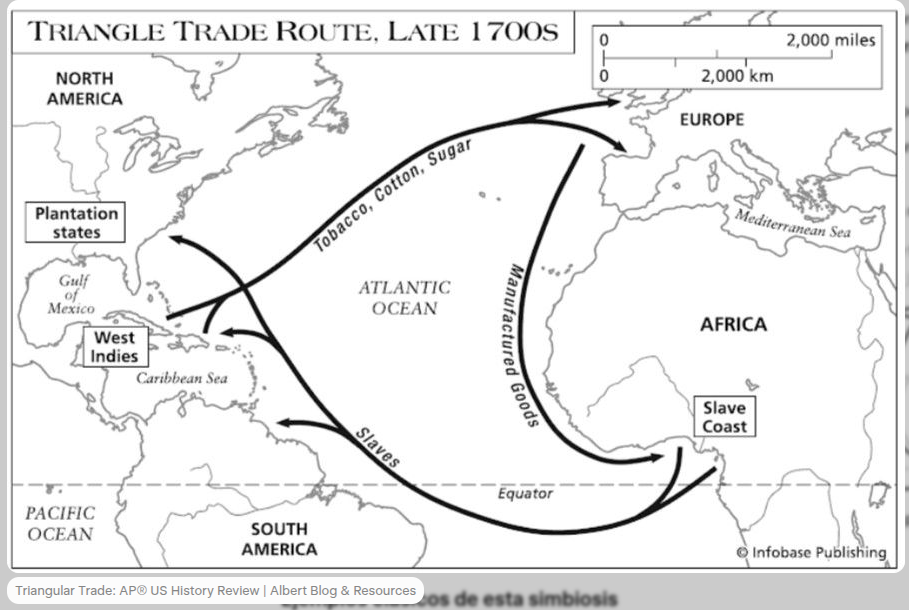
Europe sent manufactures → Africa sent slaves → America sent raw materials (sugar, tobacco, cotton) → and the cycle continued, always controlled by the metropolis.
Classic examples of this symbiosis
Spain:
The purest system. The Casa de Contratación of Seville and the fleet system controlled all trade with America. The silver of Potosí and Zacatecas flowed to Spain… and from there left rapidly toward other countries because Spain produced almost nothing competitive. Despite the enormous extractive wealth, Spain entered relative decline.
Great Britain:
-
The Navigation Acts (1651 onward) were pure mercantilist legislation. The American colonies could only export and import in British ships and almost exclusively with England. This generated great resentment and was an important cause of the American Revolution (1776).
-
Privileged companies: The British East India Company, the Dutch VOC, and the Portuguese were private firms with monopolies granted by the State, their own armies, and rights of conquest. A perfect example of crony capitalism on a global scale.
Perspective from Austrian economics
Classical colonialism is a manifestation of state mercantilism and interventionism, not of free-market capitalism:
- It was a system of monopolistic privileges granted by the State (East India Company, Casa de Contratación of Seville, etc.).
- It generated price distortions and massive corruption, instead of a genuine international division of labor based on private property and voluntary exchange.
- Ludwig von Mises and Murray Rothbard argued that true classical libertarianism (free trade, non-intervention) would have been far more beneficial for the colonies than mercantilist colonialism. Free trade allows each region to specialize according to its theory of comparative advantage without need of conquest.
Summary:
- Colonialism was not a “capitalist” adventure (see Definition of Free Market), but a mercantilist-state enterprise, an economic nationalism, state capitalism, or political capitalism.
- It was economic nationalism at the international level: the State granted monopolies and privileges to connected firms and groups, who in turn financed and legitimized the State.
- The link between colonialism and mercantilism is one of the tightest and most revealing in economic history. We can practically say that modern European colonialism (sixteenth–eighteenth centuries) was, to a large extent, the territorial and practical expression of mercantilism.
This explains why many Austrian and revisionist economic historians hold that the great enrichment of the West did not come mainly from colonial plunder, but from the institutions of private property and trade that developed despite mercantilism, especially in the Netherlands and England from the eighteenth century onward.
This article is part of the Intermediate course on Libertarianism and the Austrian School of Economics -> Module 2: Mercantilism
| Previous topic | Next topic | |
|---|---|---|
| <- Mercantilism | <--> | Transatlantic Slavery-> |
Last updated: 2026-06-03
| | | |
This site was written based on publicly available free articles from the internet.
The content of this site is available under the: Creative Commons Attribution 4.0 International (CC BY 4.0) license.
You can freely copy, redistribute and modify the material, as long as the source is mentioned: liberwiki.com