


Transatlantic Slavery
This article is part of the Intermediate course on Libertarianism and the Austrian School of Economics -> Module 2: Mercantilism
Last updated: 2026-06-03
Transatlantic Slavery
Slavery: a historical phenomenon prior to mercantilism
Slavery existed in practically all complex societies: Mesopotamia, Egypt, Greece, Rome, the Islamic world, precolonial Africa, and the pre-Columbian American civilizations. It was based on the capture of prisoners of war, debts, punishments, or birth into servitude.
Philosophically, it contradicts the principle of self-ownership, which the Austrian School (Mises, Rothbard) considers axiomatic: the human being is owner of his body and his labor.
Biologically, it goes against the voluntary cooperation that characterizes human action and that allowed the development of prosperous societies.
However, the form that most interests us here —transatlantic slavery— acquired an industrial scale thanks to European mercantilism.
The intimate relationship between slavery and mercantilism: the triangular trade
Mercantilism needed colonies and these needed cheap and coercive labor to produce the export goods (sugar, tobacco, cotton, coffee, indigo) that generated the commercial surplus.
The indigenous American population collapsed from disease and exploitation, so African slaves were resorted to massively.
As explained earlier, this system was organized through the triangular trade:
- Europe → Africa: ships loaded with manufactures (cloth, arms, alcohol, tools) that were exchanged for slaves captured by African kingdoms or local traffickers.
- Africa → Americas: the infamous Middle Passage, where slaves were treated as merchandise (high mortality).
- Americas → Europe: raw materials produced on slave plantations that were sold in Europe, closing the cycle and generating profits.
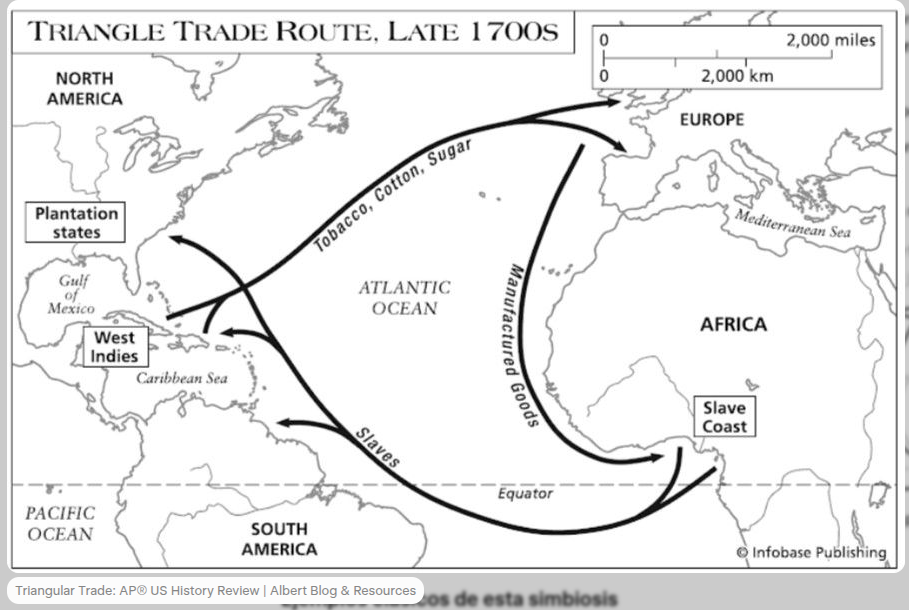
This circuit was not a “free market” or “pure capitalism” (see Definition of Free Market), but a system highly regulated by state monopolies (such as the British Royal African Company or the Spanish Casa de Contratación) and by mercantilist laws that prohibited the colonies from trading freely.
Slaves were considered a strategic input to maximize the metropolis’s exports and minimize its imports. Countries such as England, France, and Portugal built a large part of their naval and commercial power on this model.
Mercantilism made slavery a state economic pillar.
Mercantilism did not “invent” slavery, but it industrialized it and integrated it into the heart of its colonial-statist project.
This illustrates perfectly how state intervention and the rejection of Private Property and individual liberty generate human suffering and economic distortions that only the spontaneous order of the free market can overcome.
True wealth is productive capacity (goods and services), not accumulated gold.
This article is part of the Intermediate course on Libertarianism and the Austrian School of Economics -> Module 2: Mercantilism
| Previous topic | Next topic | |
|---|---|---|
| <- Colonialism | <--> | Crony Capitalism-> |
Last updated: 2026-06-03
| | | |
This site was written based on publicly available free articles from the internet.
The content of this site is available under the: Creative Commons Attribution 4.0 International (CC BY 4.0) license.
You can freely copy, redistribute and modify the material, as long as the source is mentioned: liberwiki.com