


War Communism
This article is part of the Intermediate course on Libertarianism and the Austrian School of Economics -> Marxism
Last updated: 2026-06-07
NOTE: To understand the concepts named in this article it is advisable to have read the articles of Module 6: Free-Market Economics
War Communism (1918–1921) implemented by Vladimir Lenin and its most devastating consequence: the Soviet Famine of 1921.
This period historically represents the most radical attempt to completely dismantle the spontaneous order of a society in order to replace it with centralized constructivist planning. The subsequent famine was not a mere climatic accident, but the direct and inevitable consequence of destroying economic calculation and the biological incentives of survival.
Below is a breakdown of the concrete actions of Lenin’s government and the collapse they provoked:
1. The Concrete Actions: Confiscation and Abolition of the Market
To uproot capitalism completely, the Bolshevik regime applied extreme measures aimed at eliminating private property and the monetary economy:
-
Forced Grain Requisition (Prodrazvyorstka):
- Faced with urban shortages, the government banned free trade in agricultural surpluses.
- In its place, it implemented a coercive system in which armed detachments of the Cheka (regime police) and the army confiscated not only the peasant’s surplus, but in many cases even the grain needed for basic consumption and the following year’s sowing.
-
Destruction of Private Property and Demonetization:
- All industries were nationalized, private retail trade was outlawed, and an attempt was made to abolish the use of money through deliberate hyperinflation.
- The State intended to ration resources in a top-down and centralized way, assuming that a bureaucratic board possessed the capacity to coordinate the feeding of millions of people.
2. The Informational and Economic Collapse
By suppressing property rights and free prices, Lenin’s government mutilated society’s signaling system:
-
Annihilation of Incentives:
- Knowing that any productive surplus would be seized by force, the peasants responded in a logical and natural way: they drastically reduced the area under cultivation. Why strive to produce what will be confiscated at bayonet point?
-
Paralysis of Economic Calculation:
- Without a market where prices reflected real scarcity, central planners became economically blind.
- There was no way to know how much grain was needed, where to distribute it optimally, or at what logistical cost.
3. The Extreme Consequence: The Soviet Famine of 1921
-
The institutional rigidity imposed by state constructivism eroded the population’s adaptive resilience.
-
When in the spring of 1921 a severe drought struck the Volga region and southern Russia (ruining about 22% of the crops), the reserve granaries were already completely empty because of prior requisitions.
-
In a market spontaneous order, the rise in prices would have attracted flows of grain and investment from other unaffected regions to mitigate the scarcity.
-
Under Central Planning, the result was the Famine of 1921, a politically induced humanitarian catastrophe that cost the lives of approximately 5.1 million people.
- Although some recent demographers raise the figure to 6 million or more (up to 8–10 in high ranges). It mainly affected the Volga region, but also parts of Ukraine and other zones.
-
The biological dynamics of the population collapsed, provoking extreme levels of malnutrition, typhus epidemics (spread by lice), and generalized scenes of social despair.
-
Additional horror: There were thousands of documented cases of cannibalism. Gangs killed children to sell their flesh as “horse meat.” In some areas, a significant proportion of the meat in circulation came from human beings.
-
In addition to the famine, there were mass peasant revolts.
- The most important was the Tambov Rebellion (1920–1922), one of the largest peasant insurrections against the Bolshevik regime, brutally repressed (even with chemical weapons).
- The Kronstadt rebellion (sailors who had supported the Bolsheviks) also broke out in 1921 for the same causes.
Images of the Russian Famine of 1921
The following images were downloaded from the following sites:
and by simply searching the internet for “Russian Famine 1921” they appear from other sites; they are practically public images on the internet.
| Image |
|---|
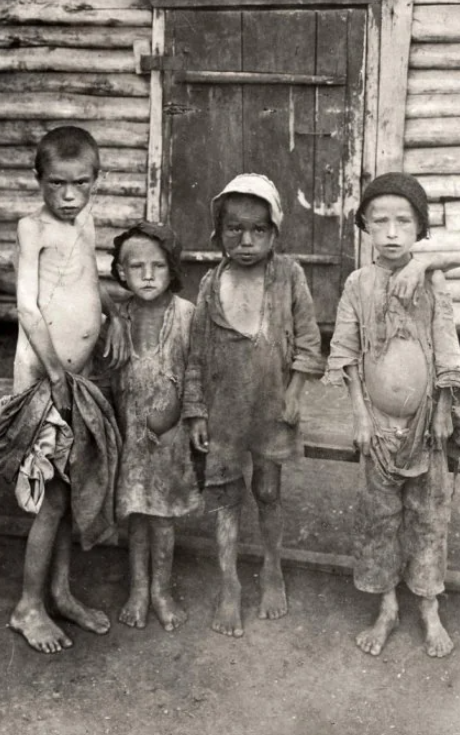 |
| Many children were left orphaned because of the diseases their parents contracted |
| Image |
|---|
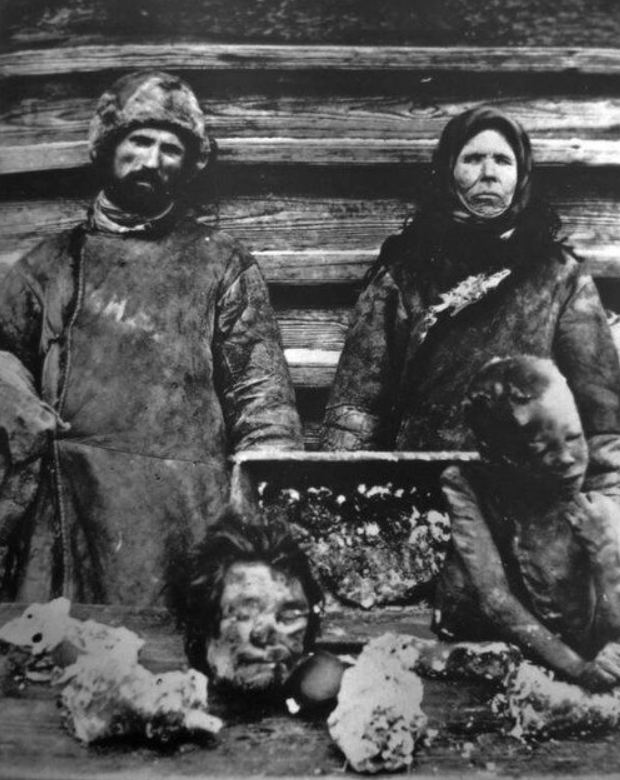 |
| A Soviet couple from Samara province sell human remains at a market stall in the winter of 1921. Many people resorted to eating human flesh to survive. |
4. The Strategic Retreat: The New Economic Policy (NEP)
The disaster was of such colossal magnitude that it unleashed mass peasant insurrections (such as the Tambov Rebellion) and the military uprising of the Bolshevik sailors themselves at Kronstadt.
Faced with the imminent danger of losing absolute power through the country’s total paralysis, Lenin was forced in 1921 to make an ideological retreat and admit the failure of War Communism. This gave way to the New Economic Policy (NEP), which consisted concretely in:
- Legalizing private retail trade again.
- Replacing forced and violent requisitions with a fixed tax in kind.
- Allowing peasants to sell freely their remaining surpluses on a restored market.
The NEP was an implicit recognition of the failure of socialist economic calculation (as Ludwig von Mises foresaw in his 1920 article on the impossibility of economic calculation under socialism).
After the NEP, agricultural production resurged practically immediately; partially returning property and price signals demonstrated empirically the great premise of the Austrian School: the spontaneous order of human exchanges cannot be supplanted by top-down design mandates without condemning civilization to informational chaos, misery, and the destruction of life.
This article is part of the Intermediate course on Libertarianism and the Austrian School of Economics -> Marxism
| Previous topic | Next related topic | |
|---|---|---|
| <-Böhm-Bawerk's devastating critique of Marxism | <---> | GOSPLAN and the Holodomor-> |
Last updated: 2026-06-07
| | | |
This site was written based on publicly available free articles from the internet.
The content of this site is available under the: Creative Commons Attribution 4.0 International (CC BY 4.0) license.
You can freely copy, redistribute and modify the material, as long as the source is mentioned: liberwiki.com