


Achievements of the Free Market for Humanity
This article is part of the Basic Course on Libertarianism and the Austrian School of Economics-> Module 5: Austrian Economics and Free Market
Last updated: 2026-06-03
The Free Market, understood as the system of private property, free voluntary exchange, entrepreneurship, and free prices—is one of the greatest achievements in the history of humanity.
The historical context: breaking the Malthusian Trap
For thousands of years (from the Neolithic Revolution until approximately the eighteenth century), humanity was trapped in a Malthusian equilibrium: any increase in production translated into more population, but real income per capita barely moved.
Extreme poverty was the norm for the great majority (around 75–90% according to historical reconstructions). Life expectancy hovered around 25–35 years on a global average, and existence was precarious, with recurrent famines and low productivity.
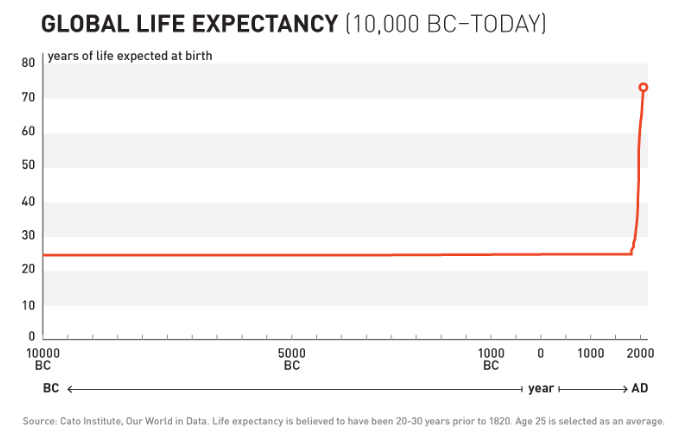
The rise of modern capitalism (with roots in the Commercial Revolution, the development of property rights in the Netherlands and England, and explosion in the Industrial Revolution) broke that ceiling. Suddenly, sustained and intensive economic growth appeared (not only extensive).
This was not due to Central Planning, but to the Dispersed knowledge and Spontaneous order that Friedrich Hayek described: millions of individuals acting according to their knowledge, coordinated by prices and the pursuit of profit.
Massive reduction of extreme poverty
It is probably the greatest humanitarian triumph in history.
Historically, poverty, unsanitary conditions, and vulnerability to nature were not “problems that arose,” but the default condition of humanity.
The true historical miracle has not been the existence of poverty, but the systematic generation of wealth.
Contrasting historical evolution from the Industrial Revolution to the present, one observes that the percentage of the world population trapped in extreme poverty went from exceeding 90% to standing below 10%.
According to data from the World Bank and Our World in Data, the proportion of people in extreme poverty (less than ~$2/day adjusted) went from around 75–90% in 1820 to less than 10% today.
Only since 1980–1990, more than 1,000–1,300 million people left it, especially with market reforms in China, India, Vietnam, and other emerging countries.
Economic growth explains the great majority of that reduction (often 70–85% according to studies), not only redistribution. Countries and periods with more economic freedom show much faster declines.
As of 2026 we are approximately 8.3 billion people; this would not be possible if we were not capable of producing food, goods, and services at the scale necessary to feed all those people.
The empirical contrast against constructivism:
History showed that while experiments in Central Planning (such as Lenin’s War Communism in 1918 or Stalin’s GOSPLAN) resulted in catastrophic informational collapses that cost the lives of millions of people by starvation (such as the Soviet Famine of 1921 or the Holodomor), the regions that adopted, even partially, market institutions experienced an immediate flourishing of their food and productive resilience (as occurred with the restoration of prices under the New Economic Policy — NEP).
NOTE
Here we are speaking of extreme poverty, taking as a baseline the normal state of poverty in the eighteenth century. There exist today other (debatable) indicators of world poverty that place it at higher values (between ~20% and ~50%), since they consider that to be above the poverty line one requires access to more and better products and services.
These other indicators show that in order not to be poor, one needs not around “$2 per day,” but between “$3 and $10 per day” not to be poor.
The problem with these indicators is that they are not comparing the same conditions of the eighteenth century; they compare “apples with stones.” The poverty conditions on which these indicators are based are sometimes similar to the living conditions of people who could have been considered upper middle class or rich in 1700.
Here we compare current extreme poverty with extreme poverty of the eighteenth century. We are not asking what is required according to twenty-first-century cultural thinking in order not to be considered poor.
In the majority of countries where poverty is extreme, practically no condition that guarantees the free market exists (the power of the State stands above all persons).
Explosion in life expectancy and quality of life
Global life expectancy went from around 30–32 years at the beginning of the nineteenth century / 1900 to more than 71–73 years today.
This is not only due to medicine (which also advanced thanks to market incentives), but to nutrition, sanitation, housing, and accumulated knowledge that only capitalist productivity could finance and diffuse on a massive scale.
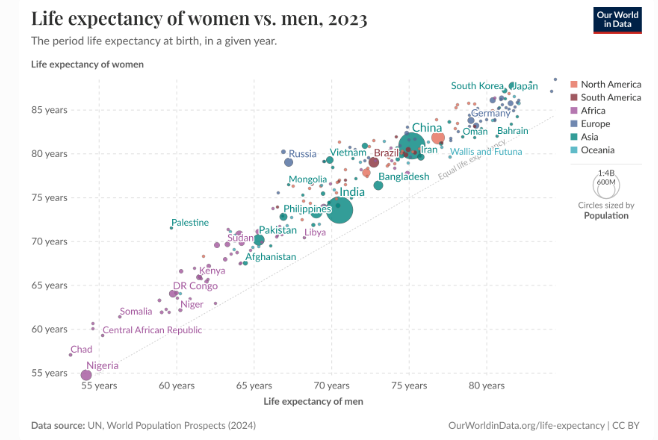
Infant mortality, hunger, and poverty-related diseases fell dramatically where capitalism was allowed.
Unprecedented technological innovation and productivity
Capitalism liberates human action and entrepreneurial discovery. The profit motive and competition act as a process of evolutionary selection: it rewards solutions that improve the lives of others.
The result: electricity, antibiotics, the internet, high-yield agriculture, cheap global transport, smartphones… Things that would have seemed magic 200 years ago are now accessible to billions.
World income per capita multiplied by more than 10–15 times in two centuries in real terms.
Biologically and Evolutionarily: The mutation of the human adaptive niche
From a pure biological optic, the evolution of living beings is inexorably marked by the Malthusian scarcity of calories and territory, which habitually triggers destructive Darwinian competition (violence, starvation, or punitive natural selection). Capitalism altered this constant.
Substitution of violence by cooperation:
Through free markets, humanity discovered that the biologically infinite desires for expansion could be channeled peacefully through Ricardo’s Theory of comparative advantage as described by Mises in Human Action.
Individuals ceased to see the “other” as a biological competitor to be exterminated in order to take away his livelihood, and came to see him as a cooperating partner in the division of labor.
The free market is, in essence, the greatest mechanism of pacification and symbiosis ever developed.
Philosophically: The shielding of Individual Liberty
Capitalism is not merely a technical system of allocating goods; it is the direct economic correlate of an ethical philosophy based on rational natural law and the inalienable rights of the person.
Consumer sovereignty versus political power:
- In a pure market economy, power is centered on the individual.
- Business profit does not derive from institutionalized coercion (typical of mercantilism, corporatism, or crony capitalism), but from the capacity to serve as well as possible the subjective needs of consumers.
- A great capitalist retains his position only if civil society validates his decisions daily by buying his products.
The emergence of spontaneous order (Cosmos):
-
The greatest philosophical and institutional achievement of capitalism is to demonstrate the viability and superiority of Spontaneous order over designed order (Taxis).
-
Human civilization has reached its highest peaks of artistic, scientific, and moral complexity not thanks to the dictates of a central board of bureaucrats or benevolent dictators, but due to the free interaction of autonomous individuals governed by general and abstract rules of conduct (justice, property, and non-aggression).
Conclusion
Capitalism is not perfect (no system made by humans is), but it has been the most powerful engine that humanity has discovered for converting scarcity into relative abundance, misery into opportunity, and precarious survival into flourishing.
It has allowed billions of people to live longer, healthier, more educated lives freer to pursue their ends than in any other era.
This article is part of the Basic Course on Libertarianism and the Austrian School of Economics-> Module 6: Free-Market Economics
| Previous topic | Next related topic | |
|---|---|---|
| <-The efficiency of the Free Market | <---> | Examples of Free Market success -> |
Last updated: 2026-06-03
| | | |
This site was written based on publicly available free articles from the internet.
The content of this site is available under the: Creative Commons Attribution 4.0 International (CC BY 4.0) license.
You can freely copy, redistribute and modify the material, as long as the source is mentioned: liberwiki.com