


Libertarianism versus Collectivisms
Categories: Home -> Philosophy
This article is part of the Intermediate course on Libertarianism and the Austrian School of Economics
Last updated: 2026-06-22
The real “battle of ideas” is not “left versus right,” but Individual Liberty versus Collectivism in any of its forms.
The left–right axis is, to a large extent, a lie that obscures the real conflict.
Why the left–right scheme is insufficient
The traditional left–right spectrum arose from the French Revolution (those who sat on the left of the Assembly wanted more radical change; those on the right, more conservation of order). But that axis never captured well the problem of Individual Liberty versus collective power.
Historically:
- The left
- has produced class collectivisms: Marxism, Leninism, socialism, current identity progressivism.
- All subordinate the individual to a “collective good” (the working class, equity, inclusion, etc.).
- The right
- has produced collectivisms of nation, race, or tradition: fascism, National Socialism, economic nationalism, authoritarian conservatism, right-wing populisms.
- All subordinate the individual to another type of collective (the fatherland, the race, the “traditional community,” “order”).
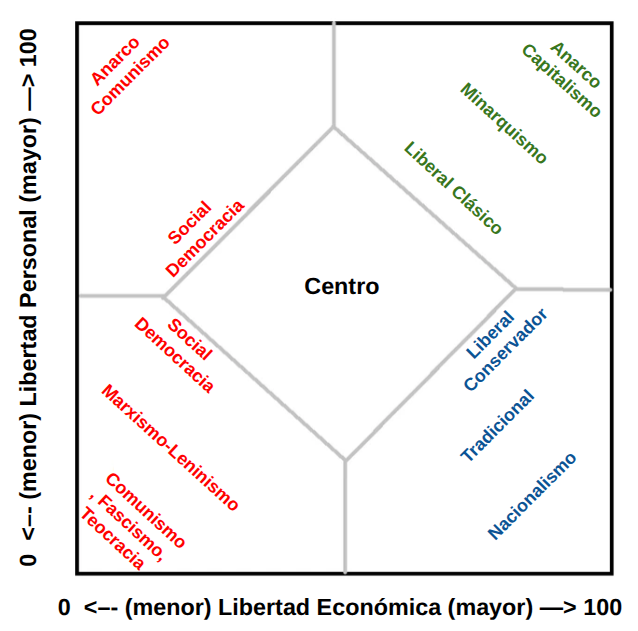
Both the collectivist left (Marxism, socialism) and the supposed nationalist or corporatist “right” (fascism, mercantilism) commit the same philosophical error: holism or conceptual realism.
They treat abstractions such as “the State,” “the Social Class,” “the Race,” or “the Nation” as if they had goals and rights superior to those of the real flesh-and-blood individual.
Both sides, when they are coherent, reject the liberal principle that society should be organized from free individuals who possess rights and property, and who cooperate voluntarily.
Both tend to see the individual as part of a greater whole that has priority.
That is why Friedrich Hayek wrote Why I Am Not a Conservative (1960): the conservative often defends the status quo or tradition for its own sake, even when that tradition includes state privileges, Protectionism, or arbitrary authority.
The liberal, by contrast, judges institutions according to whether they respect or violate individual liberty, regardless of whether they are “of the left” or “of the right.”
Mises, for his part, insisted that the problem was not “capitalists against proletarians,” but private property versus collective property (or state control). That dichotomy cuts across any party label.
The more precise axis: individualism vs. collectivism
From the Austrian economics perspective, the real conflict is better ordered as follows:
| Principle | Free market / Individualism | Collectivism (left or right) |
|---|---|---|
| Human Nature | The sovereign individual | The group (class, nation, identity, State) |
| Basic unit | The sovereign individual | The group (class, nation, identity, State) |
| Rules of Society | Abstract Ethics | Tribalism |
| Value of things | Subjective; each person assigns to things the value they want | Objective; things have a fixed value and no one can change them |
| Property | Private and voluntary The result of work belongs to the worker. |
Collective or controlled by power The result of work can be expropriated by social justice |
| Social order | Spontaneous order (result of individual actions) |
Constructed / Central Planning |
| Knowledge | Dispersed knowledge, Subjective, impossible to centralize | Concentrated in an elite or “vanguard,” Objective |
| Method of coordination | Prices, contracts, personal responsibility | Coercion, central planning, privileges |
| Psychological and evolutionary consequences | Maturity | Infantilism and Contempt for Human Intelligence |
| Historical examples | Classical libertarianism, competitive capitalism | Socialism, fascism, Peronism, economic nationalism, identitarianism |
This table shows why the free market is not “of the right” in the traditional sense. It is the practical consequence of respecting individual liberty and property.
When a “right-wing” government imposes tariffs, subsidies, price controls, or a fusion between the State and large firms, it is practicing a form of collectivism (interventionism or corporatism), even if it uses nationalist rhetoric.
Spontaneous Order vs. Constructivist Design
If you analyze the current political spectrum, both the left and a large part of the traditional right advocate state intervention in the market (through price controls, customs barriers, subsidies to friendly entrepreneurs, or monopolies of monetary emission).
For an Austrian economist, both sides of that spectrum share the same intellectual disease: constructivist rationalism (what Friedrich Hayek called the fatal conceit).
The knowledge problem:
The knowledge needed to coordinate a civilized society is dispersed, subjective, fragmentary, and trapped in the minds of millions of local agents.
The line of demarcation:
-
The Free Market solves this informational problem horizontally through Spontaneous order and the free price system.
-
Collectivism (whether under the facade of Soviet Gosplan planning or the “socialism of the German pattern” of fascism, where private property is kept in name but the State dictates what to produce and at what price) destroys this circuit. By forcibly centralizing economic command, the planner goes blind, which destroys Economic calculation and collapses the allocation of wealth.
From Institutional History
History shows that when collectivist regimes assume total control, the economic and totalitarian results are identical, regardless of whether they proclaimed themselves “of the right” or “of the left”:
The case of Fascism/Nazism:
Historically they are catalogued as “far right,” but praxeologically they emptied of content consumer sovereignty and private property.
As Mises explained, they operated as a collectivism of vertical control where industries (such as IG Farben or Krupp) did not respond to the market, but to four-year plans dictated by bureaucrats, pursuing customs protectionism, price fixing, and military aggression.
The case of Lenin’s War Communism:
Classified as “far left,” it pursued exactly the same end: abolish the market and replace it with central command.
The common diagnosis:
Both systems are branches sprung from the same statist trunk that frontally oppose individual liberty and voluntary exchanges.
That is why Hayek titled his masterwork The Road to Serfdom, warning that moderate interventionism (whether from the conservative right or social democracy) gradually pushes society toward totalitarianism.
From biology and evolutionary theory
From a broader perspective (combining Austrian economics with evolutionary biology and complex systems theory), the human being did not evolve as an ant in an anthill nor as a piece of a central plan.
We evolved as individuals who cooperate through emergent abstract rules (property, reciprocity, division of labor). The extended order of the market —as Hayek called it— is an evolutionary phenomenon, not a rational design imposed by a collective authority.
Any form of collectivism (whether the “dictatorship of the proletariat” or the “national community”) tries to replace that Spontaneous order with a consciously constructed order. And, as Friedrich Hayek demonstrated in The Fatal Conceit, that exceeds the cognitive capacity of any human group.
The inevitable result is coercion and impoverishment. You can read details at this link → List of Collectivist Catastrophes.
Conclusion
The coherent liberal does not place themselves in the “center” of that false axis (left vs. right). They place themselves outside it, defending the principle that no collective —neither the working class, nor the nation, nor any group identity— has the right to sacrifice the liberty and property of the individual.
That is the distinction that really matters. Everything else is tactical labels that usually serve to disguise new forms of collective power.
This article is part of the Intermediate course on Libertarianism and the Austrian School of Economics
| Previous topic | Next topic | |
|---|---|---|
| <- Basic Course on Libertarianism and the Austrian School of Economics | <--> | Aristotelian Realism -> |
Last updated: 2026-05-30
| | | |
This site was written based on publicly available free articles from the internet.
The content of this site is available under the: Creative Commons Attribution 4.0 International (CC BY 4.0) license.
You can freely copy, redistribute and modify the material, as long as the source is mentioned: liberwiki.com